
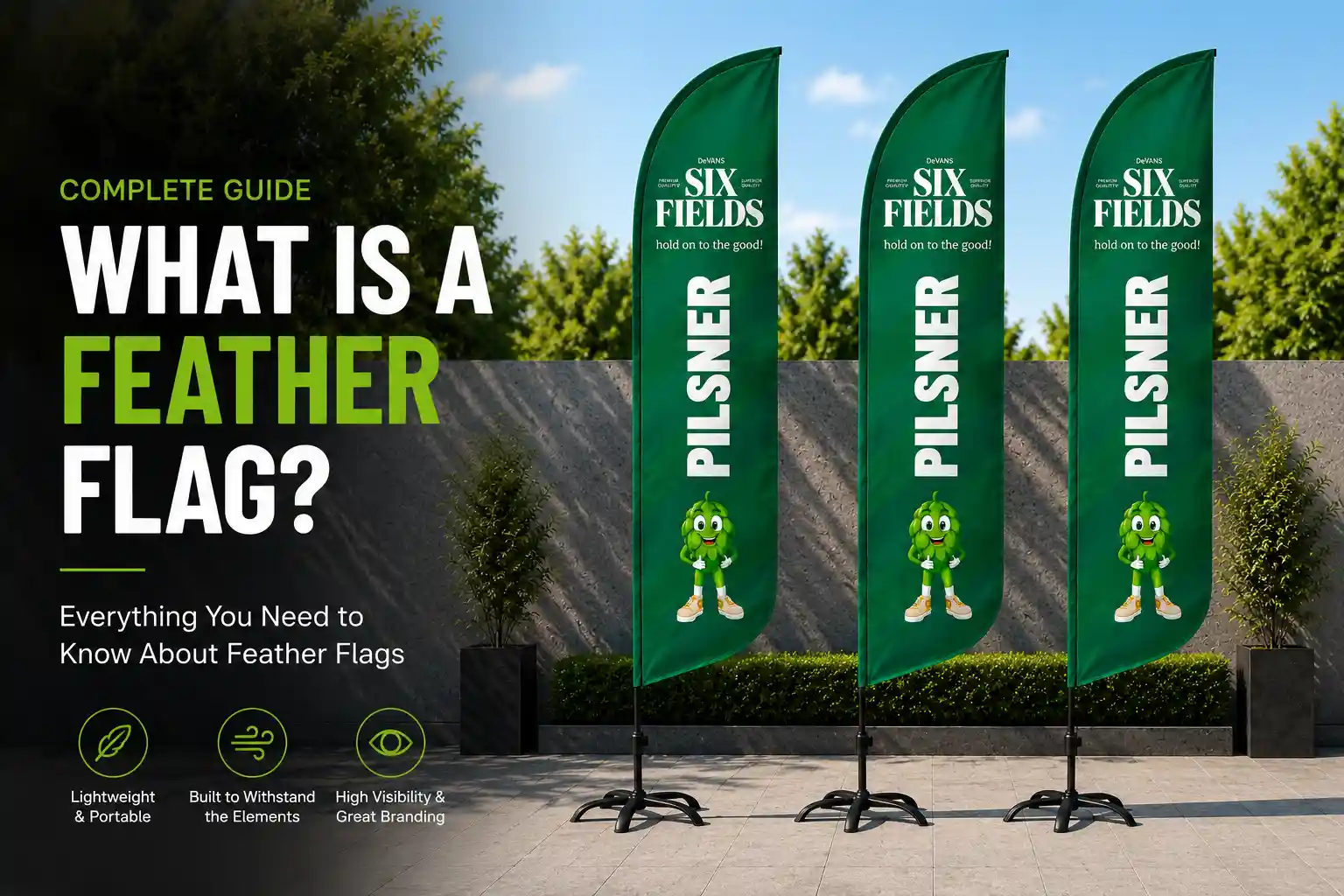
What Is a Feather Flag?
A Feather Flag is a tall, lightweight promotional flag designed exclusively to capture the attention of passersby and boost brand exposure, most commonly deployed in outdoor settings. Its structure is straightforward: it starts with a printed fabric banner bearing promotional content, which is mounted on a flexible pole. The entire pole is then secured to the ground with a matching base or ground stake, keeping the flag upright and stable. It has one highly recognizable feature: its smoothly curved shape sways when caught by the wind, and from a distance, it resembles a soft, floating feather. This characteristic is exactly how the name “Feather Flag” gained widespread use.
Unlike traditional rectangular flags and fixed banners, which are either hung or rigid and immobile, Feather Flags stand fully upright on the ground, making them immediately visible against their surroundings even from a great distance. Their slim, tall profile means they sway gently with even light breezes, rather than remaining stiff in place like rigid traditional flags. The graphics and content printed on them can also be fully customized. Thanks to these traits, they work perfectly for storefront advertising, brand building, event promotion, and directing visitors. Merchants building their brand can print their company logo, exclusive brand color scheme, quarterly promotions, contact information, or dedicated marketing slogans on the flag surface, customizing every printed detail to their exact needs.
When you are out shopping or attending an exhibition, you will often see Feather Flags outside these locations: at the entrance of retail stores, neighborhood restaurants, industry trade shows, national trade expos and university campuses, local and professional sports event venues, residential and commercial property development sites, corporate office buildings, and city-wide promotional event sites. They can be placed near building entrances, along busy roads, outside neighborhood shops, inside large event venues, or around exhibition halls, specifically designed to catch the eye of both pedestrians and drivers, ensuring no one misses the information displayed on them.
One of the most prominent advantages of Feather Flags is that they deliver high-exposure advertising without occupying much space. They are lightweight by design, making them easy to transport between different locations. They can be assembled in just a few minutes, with no need to spend time and effort building complex frames. They can also be reused for several years, surviving dozens of events or promotional campaigns instead of being disposable after a single use. As long as the graphic design is appropriate and the flag is placed in a high-foot-traffic area, an otherwise unremarkable store entrance or promotional zone can be transformed into a memorable brand touchpoint, ensuring every passerby notices the brand.
Whether you want to announce a new store opening, promote a limited-time seasonal sale, direct event attendees, market properties for sale, support a local school’s sports team, or simply expand your brand’s local visibility, a Feather Flag is a practical, eye-catching choice that can accurately deliver the message you want to convey to the target audience.
How Does Feather Flag Work
A Feather Flag requires three core components to be functional: a printed Fabric Flag, a Flexible Pole, and a stable base. Assembling these three creates a tall, free-standing independent promotional sign. The fabric must be secured along the full length of the pole. That bendable Flexible Pole perfectly supports the entire flag, keeping it upright at all times, fully stretching the fabric to prevent it from wrinkling and bunching up on the pole. Once fully installed, the flag can sway naturally with the wind, rather than remaining rigidly fixed in place. The printed graphics on it are clearly visible from a distance to passersby, with no obstructions blocking the view.
One of the core reasons Feather Flags have become a favorite in the advertising industry is their simple structure, which makes them easy to carry. Unlike other large display boards that are permanently fixed and cannot be disassembled, a Feather Flag can be assembled on any open patch of ground whenever it is needed; after use, it can be taken apart, moved, and stored in a warehouse with complete convenience. Depending on the placement location, users can also select a compatible base—there are matching models for grass, soil, concrete, indoor flooring, or any other type of ground, eliminating the risk of choosing a base that cannot be inserted or that fails to keep the flag stable.
Main Components of a Feather Flag
Fabric Flag
This fabric is the core of the flag face, with all brand logos and promotional content printed on it. It is typically made of lightweight yet durable polyester: the material is soft enough, and resistant to tearing, allowing the flag to sway freely in the wind without falling apart after only a few uses. Businesses can also fully customize it—printing logos, graphics, using brand-exclusive colors, adding promotional information, any content they wish to include, fully aligning with their own promotional needs.
Flexible Pole
This bendable pole acts as the skeleton of the entire flag, propping it up fully to prevent it from sagging. It is almost always constructed by connecting multiple short, lightweight, bendable pole sections, which can be joined to reach the required height—whether a shorter model or a taller display variant, it can be assembled to spec. The pole’s flexibility allows it to bend naturally when the wind blows, while consistently maintaining the unique curved shape characteristic of a Feather Flag, without losing form, and preserving the smooth feather-like silhouette at all times.
Ground Spike or other base types
The base’s function is to firmly secure the Feather Flag in place, ensuring it does not topple over, get flipped by wind, or even blow away no matter how long it is used. If placed on outdoor grass or soil, a Ground Spike can be inserted directly into the earth; pushing it into soft soil will keep the flag stably upright. For hard surfaces or indoor use, other base options are available, such as cross-shaped bases or weighted bases, which all attach to the bottom end of the pole. Placed on flat concrete or indoor flooring, with the weight properly added, the flag will not tip over.
Choosing the correct base is particularly important. The selected model must match the ground surface where the flag will be placed, as well as align with various conditions of the placement environment—for example, in windy locations, a more stable weighted base must be selected, otherwise problems are very likely to occur.
Pole Sleeve or Attachment System
The flag face typically comes with a pole sleeve, fabric pouch, fabric loops, or fixed attachment points, which secure the fabric firmly to the Flexible Pole to prevent it from sliding off. This set of attachment methods not only keeps the printed fabric aligned with the pole without shifting, maintaining a flat display state at all times, but also does not hinder the flag from swaying naturally with the wind, avoiding over-tightening that could tear the fabric.
As long as it is properly secured, the pole can continuously provide stable tension and support to the flag face, so the graphics on it remain fully stretched, properly displayed to every passerby, and never wrinkled to obscure the text.
Carry and Storage Bag
With this bag, transporting the Feather Flag becomes far simpler. When not in use, it also protects the flag from damage caused by bumps and knocks, preventing the pole from being scratched and the fabric from getting dirty. The short sections of the pole can generally be disassembled, and the fabric can be folded into a very small size. The entire display flag can ultimately be fit into a tiny space, making it convenient to carry anywhere. It poses no hassle to transport for market events, trade shows, or when changing the promotional location at a store.
How to Set Up a Feather Flag
Setting up a feather flag is generally quick and straightforward. While the exact process can vary depending on the flag and base system, the basic steps are:
Step 1: Assemble the Pole Sections
Start by connecting the individual pole sections in the correct order. Make sure each section is firmly connected before attaching the flag.
Step 2: Attach the Flag to the Pole
Insert or connect the pole through the designated sleeve, loops, or attachment points on the flag. Follow the manufacturer’s arrangement so that the fabric sits correctly along the pole.
Step 3: Connect the Pole to the Base
Once the flag is assembled, place the bottom of the pole into the appropriate base. Make sure the connection is secure and that the pole can support the full height of the flag.
Step 4: Secure the Base
For outdoor use, insert the ground spike firmly into suitable soil or grass. If using a weighted or cross base, place it on a stable, level surface and ensure it is positioned securely.
Step 5: Let the Flag Display
Once everything is secured, allow the fabric to naturally extend and move with the surrounding air. The flexible pole and lightweight fabric help create the flowing appearance that makes feather flags highly noticeable.
Pro Tip: Always choose a base according to the installation surface and expected conditions. A properly selected and secured base not only improves stability but also helps your feather flag maintain a professional appearance during use.
Why Is It Called Feather Flag?
The name Feather Flag comes entirely from its unique shape and appearance when set up, which is completely different from the design of traditional flags that we usually see in daily life. The ordinary flags we are used to are mostly square rectangles with straight edges, which in most cases can stand stiffly to maintain their fixed shape. Feather Flag is different: it is made tall and narrow, with a curved arc on its outer edge. When stood up and viewed from the front, it looks just like a long, floating feather.
To create this feather-like effect, two elements must work together to support it: a bendable flexible flagpole, paired with a purpose-cut flag fabric. Only when these two are combined can its unique appearance be formed. Once the flag is fully assembled, the fabric of the flag panel will follow the arc of the flagpole and cling to it, perfectly outlining that iconic feather silhouette. When the wind blows through the fabric, the flag will naturally bend and sway, catching the attention of passersby from far away.
This special design also has a key advantage: even when the wind is too weak to fully blow up and stretch out the flag fabric, people can still recognize at a glance that this is a Feather Flag. Its flag fabric is always supported by the flagpole, and does not rely entirely on the wind to maintain its original shape. Therefore, the brand logos, color schemes, and promotional text printed on the flag panel remain clearly visible all day long, and anyone can see them at a glance.
How Is Feather Flag Different From Traditional Flag?
Let’s start with the traditional flags that we see in our daily lives. Most of them are regular rectangles, and if you want all the patterns and texts printed on the flag surface to be fully exposed, you mostly have to rely on the wind to blow the flag open—on windless days, the flag hangs limply on the flagpole, and passersby cannot even see what is printed on it at all.
Feather flags follow a completely different design logic. The entire flag is supported by a curved vertical stand. This fundamentally different design not only gives it a unique shape that is completely different from that of traditional square flags, but also keeps the flag’s shape firmly fixed at all times. It will not hang limply, nor will it sway and deform. Even when the wind is weak, its shape can be recognized from far away.
Precisely because it stands tall and long, feather flags are especially suitable for being placed in various locations that need to catch the attention of passersby—they can be used at store entrances, roadside billboard spaces, various exhibitions, event sites, restaurants, schools, stadiums, and real estate promotional events. Standing tall enough, this uniquely shaped flag can be seen from a very far distance, which naturally attracts the attention of passersby.
It is also worth mentioning that not all feather flags have the exact same appearance; those produced by different manufacturers may have differences in their actual shapes. Some manufacturers’ feather flags have a very obvious curve, some are relatively straight without an exaggerated bend, and others make the flag body wider. You may also encounter similar products that resemble feather flags, which sellers sell under other names, such as feather banner or advertising feather flag. Even though these products have different shapes and names, the core feature of this type of product has never changed: they are all tall promotional flags.
What Does a Feather Flag Look Like
Simply put, it has a tall and straight Tall Vertical Shape, with a special curved line on its outer side. The overall outline comes together to look like a feather fluttering in the wind, completely different from the square rectangular banners we usually hang. This unique shape is not just for aesthetics—it serves practical purposes: it allows people far away to see the content on the flag at a glance, and when placed on the ground, it does not take up too much floor space, so it will not block paths or crowd other arrangements.
The fabric used for the flag itself is lightweight printed cloth, and a pole is fixed along one side of the entire flag, stringing the whole piece of cloth from bottom to top. This pole not only supports the cloth but also shapes that smooth curve, maintaining the unique look of the Feather Flag. If placed outdoors, even a gentle breeze will make the cloth sway naturally. A moving flag is far more eye-catching than a stationary ordinary banner, and passersby cannot help but glance at the content printed on the cloth.
Below are the Key Features of the Feather Flag:
Tall Vertical Shape
This elongated vertical design is inherently more noticeable than flat banners. Whether placed outside a store, at an entrance, at an event site, in an exhibition hall, or by the roadside, as long as it stands there, it can be seen from far away and fits anywhere.
Curved Outer Edge
It is this curve that outlines the iconic feather shape of the Feather Flag. This unique look completely distinguishes this promotional flag from traditional rectangular flags and ordinary banners, so it will not be confused with other promotional materials.
Printed Branding Area
The entire cloth of the flag is a complete large vertical canvas that can hold many printed elements: logos, brand names, promotion information, patterns, contact details, or any advertising content you want to add. All designs can be fully customized according to the specific use and scenario of the flag, and can be adjusted to suit any placement.
Pole Along One Side
This pole is installed along the inner edge of the flag. It provides structural support, stably holding up the cloth even in ordinary outdoor environments, always maintaining the unique shape of the Feather Flag so it never collapses or deforms.
Lightweight Fabric Construction
The fabric used for the Feather Flag is thin and lightweight by nature. It is effortless and easy to pack whether you need to transport it to another venue, set it up on site, take it down and store it after use, or keep it in storage long-term. It is never as hard to manage as a thick, heavy large banner. Furthermore, this material is perfectly suited for outdoor use, as it can sway naturally with the wind.
The characteristic of fluttering with the wind
One of the most attractive features of the Feather Flag is its ability to sway naturally with the wind. Even a light breeze passing through the cloth will make it swing gently. Moving objects inherently catch the attention of people around them, while all the brand information printed on the cloth remains fully visible, never blocked by the fluttering motion. It captures ample attention while effectively spreading promotional content.
Which Type of Feather Flag Should You Choose?
You don’t have to pick haphazardly when choosing a feather flag. To pick the right style, you only need to focus on two core points: where you plan to place the flag, and which direction passersby will view it from.
If people will only pass by from one direction, a flag printed with content on one single side is sufficient, and you won’t need to spend extra unnecessary costs. If you place it in a location with mixed foot traffic and multiple passing directions, so that passersby can see the content on the flag no matter which direction they come from, it is more practical to choose a flag printed with content on both sides.
If you place it indoors, most indoor floors are smooth wood floors or floor tiles, which you cannot insert a flag directly into. You will need to pair it with a dedicated floor-standing base to stabilize it. If you place it outdoors, if you insert it into soil or a lawn, you can use a ground spike that can pierce into the soil to secure it; if you place it on a hard surface such as cement or asphalt, you will need to use a weighted base loaded with heavy objects, otherwise it will topple over when the wind blows.
For businesses that want to build their brand, a custom feather flag is perfectly suitable. It has the practical value of ordinary promotional flags that can be placed out to attract attention, and it can also incorporate all designs that fit your brand’s tone. Whether it is your brand’s exclusive color scheme or logo, everything can be printed on the flag to help strengthen your brand image.
Where Are Feather Flags Used?
It is an extremely versatile promotional prop. Unlike some promotional materials that can only be placed in specific locations, it can be set up in all types of businesses, event venues, institutions, and outdoor scenarios.
It is tall enough to be spotted from far away, the patterns and content on it can be customized freely and modified completely according to your own needs, it is easy to disassemble, pack up, and transport, so you can move it whenever you need to relocate it. It sways back and forth in the wind, which is extremely eye-catching, making it far more likely to capture passersby’s attention than a static sign standing still. As long as you need people to quickly notice a brand, notice, promotion, or direction, placing a feather flag is the right choice. From small retail stores of only a few square meters on the street to large-scale sports events that can accommodate tens of thousands of people, it can guide passersby’s gaze to the location you specify, and help more people remember your brand instead of forgetting it right after seeing it.
Retail Stores
For those running retail stores, you can use feather flags to guide passersby’s attention to your storefront. Before customers even enter the store, they can see the promotional information you want to push from dozens or even hundreds of meters away, piquing their interest in advance.
You can place it next to the entrance, in the parking lot, by the roadside, or outside a temporary promotion zone. You can print the following content on the flag: store entrance, grand opening, new product launch, discount and seasonal promotion, exclusive offers, new arrivals, clearance sale, and various promotional events, to clearly convey the information you want to share with people passing by.
For example, place flags printed with “SALE”, “GRAND OPENING”, or “NEW ARRIVALS” in an appropriate location, and passing customers will easily notice the store, instead of walking right past the storefront without even noticing the store exists.
Restaurants and Cafés
Those running catering venues such as restaurants, cafés, and bakeries can also use feather flags to attract people passing by on foot or in cars in the surrounding area; after all, offline catering relies most on local customer traffic.
The content on the flag needs to persuade people to stop and enter the store, or try the offers you have launched, and must not be too generic. Common promotional content includes: business hours, signature menu items, catering discounts, seasonal promotions, new branch openings, grand opening, takeout and delivery services, all of which are messages that can directly convince passersby to stop in their tracks. Placing the flag near the road, at the storefront, or next to an outdoor seating area can easily boost the store’s local exposure, letting more people in the surrounding area know about the store, and gradually build up local popularity.
Real Estate Industry
The real estate industry is also one of the main scenarios where feather flags are used. Developers, builders, real estate agents, or marketing teams can all use them. First, they make a project’s location easier to find—even someone visiting for the first time will know they have reached the right place as soon as they spot the flag from a distance. Second, they can attract the attention of potential homebuyers, making people who were just passing by willing to stop and look at information about the property.
They can be used for the following purposes: property launch, marking the entrance of construction sites and project venues, open house viewings, residential project promotion, commercial property promotion, route guidance, marking the location of the sales office, covering most of the promotional needs of a real estate project from the start of construction to the final sale.
Feather flags printed with the property’s brand can also make the entire venue look more organized and professional, avoiding the mess of scattered signs and posters, while deepening everyone’s brand impression of the project, making them view it as a reliable development.
Exhibitions and Various Events
When participating in exhibitions, industry trade shows, conferences, music festivals and other celebratory events, or hosting corporate events, the venue is often packed with people. Hundreds of booths are crammed into the same space, and every business is fighting for attention, making it difficult to get passersby to notice your booth. Feather flags can help with this: they are tall, so your brand or booth can be recognized from far away, instead of getting lost among a pile of small signs.
Their uses include: marking booths, boosting brand exposure, acting as directional signs, displaying sponsor brands, marking the event entrance, identifying the check-in area, hosting promotional events, and they work for both wayfinding and promotional purposes. As long as you place the flag in the right spot, you don’t need to build large, immovable fixed signs. Event attendees will still be able to smoothly find the booth or area you referenced, saving you the cost of building large fixed signs, and the flags can be reused.
Schools
Educational institutions such as primary, secondary, and tertiary schools can also use feather flags for brand promotion, messaging, or to promote on-campus events. They are not only suitable for commercial businesses—nonprofit institutions like schools are fully compatible with them too.
Common scenarios include: sports events, large annual events, enrollment promotion, campus outreach, school celebrations, marking colleges and teams, new student orientation and welcome events, and they can be used for nearly all large and small events on campus.
Custom flags can be printed with the school’s emblem, representative colors, college names, team logos, or exclusive event-specific notices, fully integrating the school’s characteristics into the flag’s design to align with the school’s overall style.
Sports Events
Using feather flags at sports events delivers exceptional results. They sway gently in the wind, and their tall stature adds to the venue’s atmosphere, while also being highly visible. From a distance, they look lively and energetic, perfectly matching the vibe of a sports event.
You can customize them to be printed with a team’s representative colors, sponsor logos, event brand identifiers, or directional information. They can be used in the following ways: team brand promotion, marking event sponsors, decorating the venue, conveying directional information, marking the location of entrances and exits, delineating fan zones, promoting the event, boosting sponsor exposure, covering everything from venue decoration to practical guidance.
Whether placed on a school playground, professional gymnasium, marathon course, various championship venues, or community-hosted events, feather flags can help you create an event atmosphere with stronger brand sense, making the entire event look more organized and atmospheric.
Other Applicable Scenarios
The uses of feather flags are not limited to the common industries mentioned above. They can also be used in: corporate office buildings, gyms and fitness studios, car 4S stores, gas stations, shopping malls, political and community promotional events, religious and cultural events, various holiday markets, promotional roadshows, new product launches, outdoor bazaars—they can be used in almost any scenario you can think of that requires external promotion or wayfinding.
Why Are Feather Flags Useful Across So Many Special industries?
Their versatility comes from the combination of high exposure, portability, customizability, and simple installation. They don’t just have one single advantage—they bring together all these practical benefits.
You can easily move them from one location to another: place them at your storefront today, and if you need to set them up at a market tomorrow, you can disassemble, pack them up, and take them with you. You can redesign the graphics for different events: print discount information for a promotion this time, and print grand opening information for a new store launch next time. You can also pair them with different bases based on the type of ground you place them on, so they stand stably whether on soil or cement.
No matter if your goal is to attract customers, promote offers, mark a location, support an event, or boost brand exposure, as long as it is properly designed, a feather flag can turn an originally overlooked empty space into a usable promotional spot, making use of a wasted promotional location, and achieving good promotional results at a very low cost.
Benefits of Feather Flags
Feather flags have become a popular choice for many businesses and organizations, as they seek the simplest way to gain more visibility, promote their brands, and capture the attention of passersby. They combine a tall profile, flexible movement that sways with the wind, lightweight portability, and customizable versatility, making them suitable for all scenarios—from regular daily advertising outside storefronts to large events and promotional campaigns. Below are the core benefits of choosing feather flags:
High Visibility
One of the most prominent advantages of feather flags is their height, which most ground-based static signs cannot match. The slender vertical design allows the flag to rise above surrounding trees, street signs, crowds, and even low-rise buildings, ensuring it is never blocked by nearby clutter. Whether it is a pedestrian walking slowly or a driver passing by in a vehicle, it is far easier to notice this tall, upright flag than short, fixed signs. When placed in suitable locations—such as store entrances, roadside spots, event venues, or the edges of undeveloped lots—a well-designed feather flag can catch the eye of people even from far away, drawing them over to check what store is operating or what event is being held.
Lightweight and Easy to Transport
Nearly all modern feather flags use lightweight fabric for their flag surfaces, and their flagpoles feature a detachable, flexible structure that makes relocation extremely convenient: all components can easily fit into a small carrying bag. If your business frequently participates in different events, or rearranges its promotional displays every so often, and needs to move promotional materials back and forth between indoor and outdoor venues throughout the year, feather flags are the perfect fit. Most feather flag sets also come with a dedicated protective storage bag, which keeps all pole segments, flag surfaces, and small accessories secure during transport and storage, preventing items from being lost or the flag’s printed designs from being scuffed while being moved. Disassembly only requires separating the pole sections at their connections without any forceful prying, and assembly only involves locking the segments into place along their notches, a process that poses no difficulty at all.
Set Up
Installing a feather flag requires no specialized skills, and can be completed by an average person. For the vast majority of sets, you only need to connect the pole segments one by one, hang the pre-printed flag surface, and insert the full assembly into its matching base, a process that takes just a few minutes. There is no need to pour permanent cement into the ground or install complex fixing equipment to keep the flag upright. For temporary promotions, whether on pavement, grass, or the floor of an indoor exhibition hall, a weighted base is sufficient to support the flag and display brand information, taking far less time than installing a permanent sign. This makes feather flags ideal for flash sales, impromptu event launches, or seasonal rotating promotional campaigns: there is no need to hire a construction team to prepare the venue more than two weeks in advance, as setup can be completed as late as the day before or even the same day as the event.
Reusable
Many promotional materials are single-use: once printed with event dates or seasonal discounts, they become useless waste once those periods pass. High-quality feather flags are different. With proper care and storage, they can be reused many times—simply wipe the dust off the flag surface after use, disassemble it, and store it in a cool, dry place. A feather flag printed with a brand logo can be taken to different events: it can stand outside a store during sales, and be reused for annual recurring campaigns. For businesses, this is a practical long-term promotional material that eliminates the need to produce an entirely new set of display props for every event, saving significant costs on repeat purchases.
Customizable
Feather flags offer a large printing area, with the entire flag from top to bottom able to be printed with any desired content, allowing custom brand logos and promotional messages to be displayed in full, rather than squeezed into a tiny space. Businesses can print logos, brand-exclusive colors, product images, discount information, company names, short marketing copy, event-related graphics, and contact information on their flags. A flag designed by a professional team can maintain a consistent visual style with all of the business’s other promotional materials: from flyers to posters to the feather flag, the same color schemes and fonts are used, so customers can instantly recognize the brand no matter where they encounter it, with no risk of confusing it with other companies.
Space Efficient
While feather flags use their vertical height to be visible from far away, they occupy very little ground space: a base roughly the size of a bucket’s base is all that is needed to support a full feather flag that stands several meters tall. For locations that cannot accommodate large banners, big signs, or other large advertising installations, feather flags are a perfect fit. They can even be placed along narrow sidewalks or in the corners of exhibition booths. When positioned at entrances, along walkways, in parking lots, at exhibition booths, or by the roadside, they never take up a large area the way large advertising displays do, which would block pedestrian paths or entrance and exit passageways, and they do not interfere with the normal use of the venue at all.
Cost-Effective Advertising
As reusable promotional props, feather flags are not single-use advertising spaces—unlike temporary roadside flag advertisements, which cost a fee to rent for a single week and must be removed once the rental period ends, leaving nothing behind. A one-time purchase of the same feather flag display allows it to be used for many different campaigns, in many different locations, and for many different events, resulting in an extremely low per-event cost. For small businesses and organizations seeking practical ways to boost local visibility, these promotional flags can be used in conjunction with other marketing channels: while distributing flyers and posting updates on local public accounts, a feather flag standing outside the storefront ensures that passing passersby also receive the brand’s message, with no need to pay for permanent advertising installations or invest large sums to install fixed signs. Even small budgets can achieve strong promotional results.
Attention-Grabbing Movement
The flag surface sways naturally with the wind, and even the slightest breeze will create dynamic curves in the fabric. This moving visual is extremely eye-catching, as the human eye is inherently more sensitive to moving objects and will notice them from far away. In outdoor environments, static signs can easily blend into surrounding walls, tree shadows, and other stores’ fixed displays, going unnoticed—a problem feather flags never face. Their ability to move in the wind, their height, and their bold graphics combine to make feather flags stand out exceptionally well, no matter if they are placed outside high-traffic storefronts, at event entrances, near stadiums, or in any promotional area. They rise above a crowd of stationary displays to capture the attention of every single person that passes by.
Why Do Businesses Choose Feather Flags?
The real advantage of feather flags comes from the way these features work together. They are visible, portable, reusable, customisable, and relatively simple to install, making them suitable for a wide range of promotional requirements.
For businesses that need a flexible branding solution that can be used both for everyday visibility and short-term promotional campaigns, feather flags can be an effective addition to an outdoor marketing strategy.
Feather Flag vs Traditional Banner: Which Is Better?
Feather flags and traditional banners are both useful promotional displays, but they are designed for different purposes. A feather flag uses a tall vertical format supported by a flexible pole and base, while a traditional banner is usually a flat printed graphic mounted to a wall, fence, railing, stage, or other structure.
The right choice depends on where you want to display your message, how much space you have, how people will view it, and whether you need a portable or more permanent display.
Feather Flag vs Traditional Banner Comparison
| Feature | Feather Flag | Traditional Banner |
| Shape | Tall and vertical | Usually horizontal or rectangular |
| Movement | Moves naturally with the wind | Generally remains fixed |
| Visibility | Strong vertical visibility from a distance | Depends largely on placement and mounting height |
| Portability | Lightweight and easy to transport | Usually easy to transport, depending on size |
| Installation | Uses a pole and suitable base | Usually requires mounting, tying, hanging, or fixing |
| Outdoor Use | Well suited to outdoor promotional use when properly installed | Depends on the banner material and mounting method |
| Branding | Highly customisable | Highly customisable |
| Best For | Entrances, roadsides, storefronts, events, and open spaces | Walls, fences, stages, buildings, railings, and backdrops |
When Should You Choose a Feather Flag?
A feather flag can be a better choice when your main objective is attracting attention from a distance. Its tall profile and movement make it particularly useful in open areas where people may be approaching from different distances or directions.
Feather flags are commonly suitable for:
- Store entrances
- Roadsides
- Real estate sites
- Outdoor events
- Sports venues
- Restaurants
- Exhibitions
- Promotional campaigns
They are also a good option when you need a display that can be assembled, moved, and reused at different locations.
When Should You Choose a Traditional Banner?
A traditional banner may be more suitable when you already have a surface or structure where the advertisement can be mounted. For example, banners can work well on walls, fences, stages, railings, buildings, and event backdrops.
They are particularly useful when you need a wider horizontal space for information, such as:
- Event names
- Sponsor logos
- Promotional messages
- Stage backgrounds
- Business announcements
- Large-format branding
Feather Flag or banner? Which One Is Better?
There is no universal answer to this question—no single option works for every scenario. Feather flags and traditional banners were originally designed for different promotional needs, each serving its own purpose, so they cannot be arbitrarily ranked as superior or inferior to one another.
If you need a display that can stand upright to be seen by people from a distance, sway gently in the wind, be easy to carry, and stands on its own without leaning against a wall or any other object, a Feather Flag is the right choice. If you have a flat wall, fence, or other space to hang items, and you need a wider horizontal area to spread out your advertising content for people to view, then a traditional banner is the way to go.
In some marketing campaigns, using both together leads to even better results. For example, when a merchant hosts an offline event, they can place Feather Flags in the open space outside the entrance. Passersby can spot the swaying flags from far away and naturally turn their gaze toward them; at the same time, traditional banners can be hung around the event venue, printed with detailed brand introductions and promotional messages to be fully absorbed by attendees as they enter.
Before making a final choice between the two, you must sort through all the conditions first to make your decision: what location you will place it in, how far away the audience will be, how much space you have available, whether your promotional copy is long or short, if there is a suitable flat surface for installation, if you need to move it frequently and have requirements for portability, and what specific goals you plan to achieve with it. Once you have thought through all these points, you will be able to select the option that suits you.
Feather Flag vs Teardrop Flag: What Is the Difference?
Feather Flags and Teardrop Flags are both commonly used freestanding promotional flags on the market today, chosen by many merchants for events, but their shapes and visual characteristics differ. While they appear to be similar, they actually have substantial differences. Both types of flags can be customized, printed with logos, brand content, promotional messages, and graphics, and are suitable for merchant self-use, all kinds of offline events, exhibition setup, placement in stadiums, or outdoor advertising.
Their core differences focus on three aspects: their inherent shape, their overall appearance, and how the flag fabric is fitted onto the support pole. These differences lead to very different application scenarios for each.
What Is a Feather Flag?
A Feather Flag has a tall, flowing shape with natural curves along its outer edge, looking just like a feather blowing in the wind—this is its unique signature appearance. The flag fabric is supported by a flexible pole that is only fixed along one side of the flag, perfectly pulling that one-of-a-kind curved outline into shape.
This design has many advantages: first, it creates a large vertical area to print brand content; second, it sways naturally with the wind, which is extremely eye-catching for outdoor promotions, making it hard for passersby to ignore the moving flag.
Characteristics of Feather Flags:
Curved feather-like shape
Tall and flowing appearance
Extra-large vertical brand display area
Dynamic visual effect that sways with the wind
Clearly visible from long distances
Suitable for printing promotional messages and advertising content
These flags are most commonly placed outside retail stores, restaurants, real estate projects, various events, exhibitions, and merchant business premises, mostly to attract passing foot traffic.
What Is a Teardrop Flag?
A Teardrop Flag has a rounded outline that exactly matches the shape of a water drop; its name alone lets you imagine its appearance. Compared to a standard Feather Flag, its curved top and tapering shape make it look more compact and have a more regular form, with no overly extended lines.
Its flag fabric is stretched taut over the support pole. Even when the wind is too light to move heavy fabric, it can maintain its recognizable teardrop shape, never slumping or looking limp. This feature allows Teardrop Flags to be used in both indoor and outdoor promotional scenarios; even in windless indoor convention centers, they look polished and put-together when set up.
Characteristics of Teardrop Flags:
Rounded teardrop-like shape
Compact appearance
Regular and stable shape
Clear visibility of graphics on the flag surface
Suitable for all kinds of promotional events indoors and outdoors
Can be used at merchant stores, exhibitions, event venues, and all types of promotional areas
Feather Flag vs Teardrop Flag Comparison
| Feature | Feather Flag | Teardrop Flag |
| Shape | Curved, feather-like profile | Rounded, teardrop-shaped profile |
| Appearance | Tall and flowing | Compact and structured |
| Visual Movement | Naturally waves and flows in the wind | Generally maintains a more defined shape |
| Branding Area | Tall vertical display area | Compact vertical display area |
| Overall Look | Dynamic and attention-grabbing | Clean and professional |
| Best For | Promotions, entrances, roadside advertising, events | Businesses, exhibitions, events, promotional areas |
| Outdoor Use | Well suited to outdoor promotions | Suitable for outdoor use with the appropriate setup |
| Indoor Use | Suitable with the right base | Suitable with the right base |
| Customisation | Logos, graphics, offers, and branding | Logos, graphics, offers, and branding |
Which One Should You Choose?
The choice between a feather flag and a teardrop flag depends on the look you want, available space, viewing conditions, and promotional purpose.
Choose a feather flag if you want a taller, more dynamic display with a flowing profile that can attract attention from passing pedestrians and vehicles. They are particularly effective for storefronts, roadsides, outdoor events, and promotional campaigns.
A teardrop flag may be a better choice if you prefer a more compact and structured appearance. Its rounded profile can provide a clean presentation for branding at exhibitions, businesses, sporting events, and promotional areas.
Neither option is universally better. Both are effective promotional displays—the best choice depends on your location, design, available space, visibility requirements, and branding goals.
If you’re considering a different shape for your promotional display, explore our [Teardrop Flags] to compare styles and find an option that suits your branding requirements.
What Size Feather Flag Should You Choose?
Choosing the right feather flag size is important because the size affects visibility, readability, portability, installation requirements, and the overall impact of your promotional display. There is no single size that works for every location. The ideal choice depends on where the flag will be placed and how far away your audience is likely to be.
A larger feather flag generally provides greater visibility from a distance, while a smaller flag can be more practical for entrances, indoor spaces, compact locations, and areas with limited installation room.
Factors to Consider When Choosing a Feather Flag Size
1. Available Installation Space
Start by measuring the area where you plan to install the flag. Consider both the height and the space around the base.
A large flag may be highly visible but could be impractical in a narrow entrance, crowded walkway, or restricted outdoor area. Smaller flags can work better where space is limited.
2. Viewing Distance
Think about how far away people will be when they see the flag.
If your feather flag is being used alongside a busy road or in a large outdoor area, a larger display may help your branding remain visible from further away. For a shop entrance or small event area where people are nearby, a smaller flag may provide sufficient visibility.
3. Indoor vs Outdoor Use
The environment also affects your size selection.
Indoor locations such as exhibitions, malls, conferences, and showrooms may have height restrictions or limited ceiling clearance, making smaller or medium-sized flags more practical.
For outdoor locations, there is generally more vertical space available, allowing businesses to choose larger flags when greater visibility is required.
4. Expected Footfall
Consider how people will interact with the space.
For a small shop with customers walking directly past the entrance, an extremely large flag may not be necessary. However, a busy commercial location, exhibition entrance, or large event may benefit from a taller display that can stand out among surrounding signs and structures.
5. Vehicle Traffic
If the feather flag is intended to attract the attention of passing motorists, visibility becomes especially important.
A larger flag positioned at an appropriate distance from the road can make the branding easier to notice. Keep the message simple and use large, readable text because drivers have only a short amount of time to see the display.
6. Brand or Message Length
The amount of information you want to display should also influence your choice.
If your design contains only a logo, short brand name, or simple message, a smaller flag may be sufficient. If you need to accommodate a longer promotional message or additional visual elements, a larger format may provide more usable space.
However, increasing the flag size does not mean you should fill it with more text. Feather flags are generally most effective when the message can be understood quickly.
7. Height Restrictions
Always check for any height restrictions or installation limitations before selecting a feather flag.
For example, exhibition venues, shopping centres, commercial complexes, and certain properties may have rules regarding the maximum height of temporary displays. Outdoor locations may also have specific restrictions depending on the site.
Larger vs Smaller Feather Flags
| Consideration | Larger Feather Flag | Smaller Feather Flag |
| Visibility | Excellent for greater viewing distances | Better suited to closer viewing |
| Space Required | Requires more installation space | More practical in compact areas |
| Portability | May require more effort to transport | Easier to carry and store |
| Outdoor Use | Ideal for open spaces and roadside visibility | Suitable for smaller outdoor areas |
| Indoor Use | May be limited by ceiling height | Often easier to use indoors |
| Branding Impact | Strong visual presence | More subtle and compact |
| Best For | Large events, open areas, roadside promotions | Store entrances, exhibitions, compact spaces |
What Size Feather Flag Is Best
When choosing the size of your feather flag, there is no universal “one-size-fits-all best option” that works for every location. The core principle is that the best flag is one that fits the specific site where you plan to place it. A suitable size must meet two most basic requirements at the same time: first, the promotional content printed on it must be clearly visible from a distance; second, it must not be so large that it cannot fit in your space, cannot stand stably, and creates a slew of unsolvable problems. Before you finalize your purchase size, sort through these factors first to make your decision: what is the typical distance between people who will see the flag and the spot where you place it; how much space can you actually spare to set up the flag; what group of people do you want to attract with this flag; is the surrounding environment of the flag an open main road, or a crowded indoor exhibition hall; how many words will the core promotional content printed on the flag have, and how much space will it take up; and are there any local height restrictions for outdoor displays, so you do not end up with a flag you cannot set up after purchasing it because it violates regulations and cannot be used.
If you place the flag by the road for promotion, or at the site of a large-scale outdoor event, and you need people hundreds of feet away to notice it, it is best to choose a taller flag. A sufficiently large flag face will make your brand stand out far away from the messy array of surrounding signs, easily capturing the attention of passersby. If you plan to place the flag at the entrance of a retail store, a small exhibition booth at a trade show, or a designated small promotional area indoors, and you only need to attract people passing by within a few steps to stop and take a look, you can choose a smaller, more compact flag. It will not require the effort to set up a large frame, and it can still be seen by everyone passing by.
A reminder: do not only focus on size when choosing a feather flag. A flag that is perfectly sized for your space, has a clean, uncluttered design, with large enough printed text, strong color contrast between different elements, and a message that can be understood at a glance, will often attract more people to stop and look at it for longer than a larger flag that has a messy design, with crammed text that no one can read clearly.
What Materials Are Feather Flags Made From
A complete set of feather flags is not made as a single whole piece; it is assembled from several core components, and every component affects its visual appeal, service life, how convenient it is to transport to event venues, and whether it can stay upright and stable once set up on site. All feather flags share the same core components: the printed fabric flag face, the flexible pole that supports it, and the base that holds the pole in place. The specific materials used for these components are not fixed; they vary depending on the manufacturer, the size of the flag itself, and the actual scenario where it will be used.
For a promotional feather flag to function smoothly throughout its entire service life, three indispensable conditions must be met: the flag face fabric must display the printed patterns clearly, without blurring; the pole that supports the fabric must hold the entire flag face up without collapsing, but also be able to bend with the wind, so it does not snap from being too rigid; the base must keep the entire set of flags standing stably on the ground where you install it, so it does not topple over at the slightest touch.
Flag Face Fabric
The fabric face is the most prominent part of a feather flag; your brand name and the promotional message you want to convey are all printed on this piece of fabric. Currently, the most commonly used material is polyester fabric. This material combines the practical advantages of being lightweight, flexible, and suitable for printing, which is why it has become the first choice for most people when selecting the flag face material for their feather flags.
Polyester flag face fabric has these core advantages:
Lightweight: The entire set of flags is easy to carry to event venues, unpack, assemble, and set up; you do not need to hire people to move it, you can handle it on your own.
Suitable for outdoor placement: If maintained properly, high-quality polyester fabric can be used for long-term outdoor promotion without easily breaking.
Sways with the wind: Since it is lightweight enough, when the wind blows, the fabric face will naturally flutter with the airflow, instead of standing rigid and lifeless. A fluttering flag is inherently more likely to attract the attention of passersby.
Vibrant printing results: Paired with the right printing process, polyester fabric can produce clear, brightly colored patterns that are not dull and hard to see.
Easy to carry: The flag face fabric can usually be folded or rolled into a small bundle, so it does not take up much storage space, and it is also convenient to transport to different event venues.
The choice of fabric for the flag face directly affects the final appearance of the flag once set up, as well as how long it will last. Therefore, before enterprises select a product, they must first clarify the environment where they plan to place the flag, and how often they will take it out for use, then choose the corresponding fabric, so they do not buy the wrong one that breaks after only a couple of uses.
Pole Material
The pole is the skeleton that supports the entire flag face; with this flexible pole, the unique smooth, curved shape of a feather flag that resembles a feather can be created. Most feather flag poles are made of materials that are both lightweight and flexible, such as fiberglass or composite materials, which perfectly meet the requirements for a feather flag pole.
The ability of the pole to bend is especially important. When the wind blows, it can naturally bend with the force of the wind without snapping, and at the same time, as it bends, it always keeps the fabric taut and wrinkle-free, so it does not sag into a loose pile that ruins the shape of the entire flag face. In addition to being flexible, the pole must also be sturdy enough to stably support the entire flag during normal daily use, whether it is being moved around or set up outdoors in the wind, and it will not break after only a couple of uses.
A qualified, usable feather flag pole generally has these characteristics:
- Lightweight
- Flexible
- Sturdy and durable
- Easy to assemble
- Withstands repeated bending
Perfectly compatible with the complete system of the flag face and base, with no installation issues
Most poles are not made as a single long pole; they are split into several short sections. When in use, you simply connect and lock the sections together; when not in use, you disassemble them for storage. This makes the entire set of flags very space-efficient to transport to events and store, which is extremely convenient.
Base Material
To put it simply, the function of the base is to keep the feather flag standing upright at all times, without tilting or falling over; it is the “ballast stone” of the entire flag. Which base is suitable to choose depends primarily on where you plan to install the flag; different sites may require completely different base solutions to stay stable.
Grass or Dirt Grounds
If you plan to place the flag on soft outdoor ground such as grass or soil, you can use a ground spike base. Insert the sharp ground spike into the soil, and it will firmly support the pole above it, preventing it from falling over. Whether it is placed in a private garden, a residential lawn, a school sports field, a development construction site, or various outdoor markets and events, this type of ground spike base is very practical; you just insert it and it is ready to use, with no extra steps required.
Concrete or Other Hard Surfaces
If the ground cannot accommodate a ground spike, such as flat, solid concrete or flagstone paths, you can choose a cross base or a weight base. You do not need to drill holes in the ground for a permanent installation, and it can still hold the flag stably to prevent it from falling over. It is also easy to move after use, and leaves no traces behind.
Indoor Venues
If you need to place the flag in an indoor location such as a trade show, conference room, shopping mall, or exhibition hall, you can pair it with a floor base specifically designed for flat indoor ground surfaces. It stays stable on tiles and wood flooring, and will not scratch the ground.
Water-Filled Weight Base
There is also a water-filled weight base that is especially suitable for some windy outdoor scenarios. The base filled with water is very heavy, which keeps the flag more stable than other bases, preventing it from being blown over by the wind. When in use, you fill it with water to weigh down the flag; when not in use, you empty all the water, and the empty base is lightweight, making it easy to transport or store with minimal effort.
Why Do the Materials Matter
The materials used for a feather flag directly affect its actual performance in use. If the fabric face is lightweight, it is convenient for you to handle, assemble, and disassemble, and it can also flutter naturally with the wind, attracting more attention than a rigid flag; only a flexible pole can create the unique smooth curve of a feather flag, instead of being unremarkable like an ordinary straight-pole flag; only by choosing the right base that matches your site can you keep the flag standing stably on the ground where you install it, so it does not topple over halfway through use and injure someone, or shift around.
In the end, when you choose a feather flag, do not rush to place an order just by looking at whether the printed patterns are attractive and eye-catching. You must take all these factors into consideration: the quality of the fabric, the sturdiness of the pole’s workmanship, what type of base is included, the specific location where you will place it, the typical weather conditions it will encounter, and how often you will take it out for use. Only then can you ensure that the complete set of flags you purchase fully meets all your usage requirements, and you do not end up discovering after buying it that there are issues and it does not work properly.
How Long Does a Feather Flag Last?
There is no single fixed lifespan for a feather flag because its durability depends on the quality of its materials, how frequently it is used, and the conditions it is exposed to. A feather flag used occasionally for indoor events may remain in good condition for much longer than one that is continuously exposed to strong sunlight, wind, rain, and other outdoor conditions.
When choosing a feather flag, it is therefore better to consider overall material quality and expected usage rather than relying on a specific number of years.
Factors That Affect Feather Flag Lifespan
1. Fabric Quality
The quality and construction of the flag fabric have a direct impact on durability. Good-quality polyester fabric should be lightweight enough to move naturally while being capable of handling normal promotional use.
Lower-quality fabric may fade, fray, or lose its appearance more quickly, particularly when used outdoors on a regular basis.
2. Pole Quality
The pole is constantly supporting the fabric and may flex as the flag moves. A well-made flexible pole can withstand repeated assembly and normal movement better than a poorly constructed one.
Regularly check the pole sections, connectors, and attachment points for signs of wear or damage.
3. Printing Method
The printing process can affect how long the graphics maintain their appearance. Quality printing and suitable inks can help the design remain clear and vibrant during normal use.
Continuous exposure to direct sunlight can gradually cause colours to fade, so flags used outdoors for extended periods may experience more visual wear than those used occasionally.
4. Weather Conditions
Weather is one of the most important factors affecting an outdoor feather flag. Strong winds, heavy rain, intense sunlight, and extreme weather can place additional stress on the fabric, pole, and base.
Feather flags should be taken down during severe weather rather than being left exposed unnecessarily.
5. Frequency of Use
A feather flag used occasionally for weekend events, exhibitions, seasonal promotions, or special campaigns generally experiences less wear than a flag installed outdoors every day.
Frequent assembly, exposure, and transportation can gradually affect the fabric, pole, and fittings.
6. Wind Exposure
Because feather flags are designed to move with air, they are naturally exposed to wind when used outdoors. Continuous exposure to strong or turbulent winds can put additional stress on the fabric and pole.
Using an appropriate base and removing the flag during unsuitable weather can help reduce unnecessary wear.
7. Storage
Proper storage can make a significant difference to the condition of your feather flag. Always make sure the fabric is clean and completely dry before storing it.
Keep the fabric, pole sections, and base components protected from moisture, dirt, and unnecessary pressure. A suitable carry bag can also help prevent damage during transportation and storage.
8. Cleaning and Maintenance
Regular maintenance helps preserve both the appearance and functionality of the flag. Clean the fabric according to the manufacturer’s care instructions and inspect the pole, stitching, attachment points, and base periodically.
Addressing small signs of wear early can help prevent them from becoming larger problems.
How Can You Extend the Life of a Feather Flag?
A few simple practices can help keep your feather flag in better condition:
- Use the correct base for the installation surface.
- Avoid leaving the flag outside during severe weather.
- Clean the fabric according to the manufacturer’s instructions.
- Allow the flag to dry completely before storing it.
- Store the flag in a dry, protected location.
- Transport the flag using a suitable carry bag.
- Inspect the pole and fabric regularly for signs of damage.
- Avoid dragging or unnecessarily stressing the fabric.
- Follow the manufacturer’s assembly and maintenance guidelines.
The Bottom Line
The lifespan of a feather flag depends largely on how well it is made, where it is used, how often it is used, and how well it is maintained. A quality flag that is properly installed, cared for, stored correctly, and protected from severe weather can remain a useful promotional asset for a considerable period.
Instead of asking only “How many years does a feather flag last?”, consider the complete picture: quality materials + appropriate installation + proper maintenance + suitable storage = longer-lasting promotional display.
How to Maintain a Feather Flag
Proper maintenance can help keep your feather flag looking professional and functioning properly for longer. Although feather flags are designed for regular promotional use, prolonged exposure to dirt, moisture, sunlight, and strong winds can gradually affect the fabric, printing, pole, and fittings.
A simple maintenance routine involving cleaning, proper storage, and weather precautions can help protect your investment and extend the useful life of your flag.
1. Cleaning the Feather Flag
Outdoor feather flags can accumulate dust, dirt, and other debris over time. Regular cleaning helps maintain the appearance of both the fabric and printed graphics.
- Follow the manufacturer’s washing instructions: Different fabrics may have specific cleaning requirements, so always check the care instructions before washing.
- Avoid harsh chemicals: Do not use strong bleach, solvents, or aggressive cleaning products unless they are specifically recommended for the fabric.
- Use appropriate cleaning methods: For light dirt, gentle cleaning may be sufficient. Avoid excessive scrubbing that could damage the fabric or printed design.
- Dry the flag completely: Never pack away a damp or wet feather flag. Allow it to dry fully before folding and storing it.
2. Store the Flag Properly
Proper storage is particularly important when the feather flag will not be used for an extended period.
Always make sure the fabric is completely clean and dry before putting it away. Moisture trapped inside folded fabric can lead to unpleasant odours and may contribute to fabric deterioration.
For better storage:
- Store the flag in a dry, clean location.
- Never fold or pack the fabric while it is wet.
- Keep the fabric protected from unnecessary sunlight when not in use.
- Disassemble the pole carefully rather than forcing or bending the sections.
- Keep the pole, fabric, fittings, and base components together.
- Use a protective carry or storage bag whenever possible.
Keeping all components together also makes the flag easier to transport and assemble when it is needed again.
3. Protect the Flag From Wind & Severe Weather
Feather flags are designed to move naturally in normal outdoor conditions, but severe weather can place significant stress on the fabric, pole, and base.
When strong winds, storms, or other severe conditions are expected, it is safer to take the flag down and store it until conditions improve.
You should also:
- Choose a base appropriate for the installation surface.
- Make sure the base is positioned securely and on a stable surface.
- Check that the pole is properly connected before use.
- Inspect the fabric and attachment points regularly.
- Check the pole sections and fittings for cracks, looseness, or other signs of damage.
- Replace damaged components before putting the flag back into service.
4. Check the Flag Regularly
A quick inspection before each use can help identify potential problems early. Look for frayed stitching, damaged fabric, loose attachments, bent or cracked pole sections, and worn base components.
Addressing minor issues early can help prevent further damage and keep your promotional display looking professional.
Simple Feather Flag Maintenance Checklist
Before use: Check the pole, fabric, fittings, and base.
After outdoor use: Remove visible dirt and inspect the flag for damage.
Before storage: Make sure the fabric is completely dry.
During storage: Keep all components protected in a clean, dry location.
During severe weather: Take the flag down and store it safely.
With consistent care and proper handling, a feather flag can remain a clean, attractive, and effective branding tool throughout repeated promotional campaigns and events.
Frequently Asked Questions About Feather Flags
What is a feather flag used for?
A feather flag is primarily used for advertising, branding, promotions, and directional visibility. Businesses use them to promote sales, grand openings, new products, services, locations, and special offers. They are also commonly used at exhibitions, sporting events, schools, restaurants, real estate sites, and outdoor events.
Are feather flags waterproof?
Feather flags are generally made from polyester-based outdoor fabric that can handle normal outdoor exposure, including light rain. However, being weather-resistant does not mean they should be left outside in every weather condition. Prolonged heavy rain or severe weather can affect the fabric, printing, stitching, pole, and base. It is best to follow the manufacturer’s care instructions and take the flag down during severe weather.
Can feather flags be used outdoors?
Yes. Feather flags are commonly used outdoors for storefront advertising, roadside promotions, real estate marketing, sporting events, festivals, restaurants, and other promotional activities. The correct base should be selected according to the installation surface, and the flag should be removed during severe weather conditions.
How long does a feather flag last?
There is no universal lifespan for a feather flag. Durability depends on fabric and pole quality, printing method, frequency of use, sunlight, wind exposure, weather conditions, cleaning, and storage. Proper installation and maintenance can help extend the usable life of the flag.
Can I customise a feather flag with my logo?
Yes. Custom feather flags can be printed with logos, brand colours, graphics, promotional offers, business names, and other marketing messages. For the best visibility, keep the design simple, use large readable text, and maintain strong contrast between the graphics and background.
What size feather flag should I buy?
The ideal size depends on where the flag will be installed, viewing distance, available space, indoor or outdoor use, expected footfall, vehicle traffic, and any height restrictions. Larger flags generally provide greater visibility from a distance, while smaller flags can be more practical for entrances, exhibitions, and compact spaces.
What is the difference between a feather flag and a teardrop flag?
The main difference is their shape and profile. A feather flag has a tall, flowing profile with a curved outer edge, while a teardrop flag has a rounded, teardrop-like shape. Feather flags generally provide a more dynamic appearance, while teardrop flags tend to have a more compact and structured profile. Both can be customised for promotional and branding purposes.
Are feather flags reusable?
Yes. A quality feather flag can be disassembled, transported, stored, and reused for different events and promotional campaigns. Proper cleaning, dry storage, careful handling, and protection from severe weather can help preserve the flag and its components.
How do you install a feather flag?
Installation usually involves assembling the pole sections, attaching the fabric to the pole, connecting the pole to the appropriate base, and securing the base on the selected surface. Outdoor flags may use ground spikes, while indoor or hard-surface installations can use suitable weighted or floor-standing bases.
What base is best for a feather flag?
The best base depends on the installation surface and environment. Ground spikes are generally suitable for grass or soil, while cross bases or weighted bases can be used on hard surfaces. Indoor displays typically require a suitable floor-standing base. The base should provide adequate stability for the size of the flag and the conditions in which it will be used.
Can feather flags be used indoors?
Yes. Feather flags can be used indoors at trade shows, exhibitions, conferences, shopping malls, showrooms, corporate events, and promotional displays. For indoor use, they are normally paired with a suitable floor-standing base rather than a ground spike.
Are feather flags effective for advertising?
Yes, feather flags can be an effective advertising tool because their height, movement, customisable graphics, and portability help attract attention. They are particularly useful for businesses that want to increase visibility around entrances, roadsides, events, exhibitions, and promotional areas. Their effectiveness ultimately depends on factors such as design, placement, message clarity, size, and visibility.