
// comment // tag manager code //schema starts

CMYK Printing: CMYK Color Printing, Machines & Test Prints

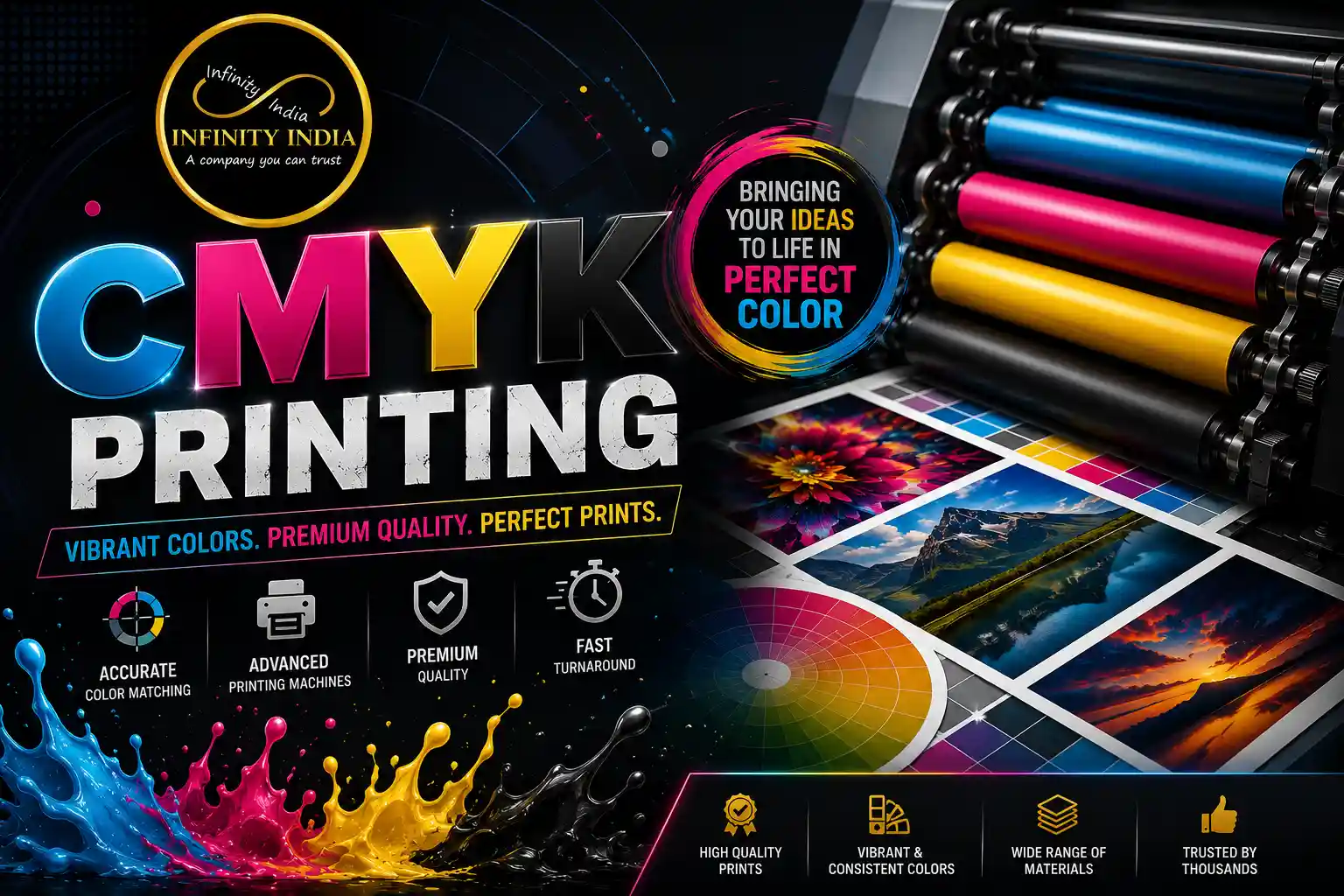
CMYK Printing explanation by infinity india flags

Introduction

If you’ve ever printed a brochure, business card, product packaging, poster, banner, or promotional material, you’ve likely used CMYK Printing without even realizing it. CMYK is the global standard for professional printing and is responsible for producing the vibrant colours and sharp details seen in millions of printed products every day.

Unlike digital screens that display colours using the RGB (Red, Green, Blue) colour model, printers rely on four process inks—Cyan, Magenta, Yellow, and Key (Black)—to recreate photographs, logos, illustrations, and marketing materials with impressive accuracy. By combining these four colours in different proportions, modern printing systems can reproduce a wide spectrum of colours suitable for commercial and promotional printing.

Today, CMYK Color Printing is used across almost every industry. Businesses depend on it for brochures, catalogues, business cards, packaging, labels, banners, exhibition graphics, fabric printing, and countless other applications where colour consistency and professional presentation are essential. Whether it’s a small batch of marketing materials or a large commercial print run, CMYK remains the preferred choice because of its reliability, efficiency, and compatibility with modern printing technologies.

Understanding how CMYK printing works can also help you avoid one of the most common printing problems—colour differences between what you see on your screen and what appears on paper or fabric. Factors such as colour mode, image resolution, print settings, and material selection all influence the final result. That’s why professional printers often recommend a CMYK Test Print before moving into full production, especially for projects where brand colours and image quality are critical.

In this comprehensive guide, you’ll learn everything you need to know about CMYK Printing, including how the CMYK colour model works, how it differs from RGB, where it’s used, the different types of CMYK Printing Machines, the importance of test prints, and practical tips for preparing print-ready artwork. Whether you’re a designer, business owner, marketer, or someone looking for professional CMYK print near me, this guide will help you make informed decisions and achieve better printing results.

What is CMYK Printing?

CMYK Printing is a professional colour printing process that uses four primary inks—Cyan (C), Magenta (M), Yellow (Y), and Key (Black)—to reproduce full-colour images, graphics, and text on a variety of printable materials. It is the most widely used colour model in the commercial printing industry because it delivers consistent, high-quality results across different types of print projects.

Unlike digital displays that create colours using light, CMYK printing works by applying layers of coloured ink onto a surface. As these inks overlap in different percentages, they produce thousands of colour combinations that closely match the original design. This method, known as the subtractive colour model, forms the foundation of modern commercial printing.

The term “Key” represents black ink because the black printing plate traditionally serves as the reference plate that aligns all other colour plates during the printing process. It also adds depth, improves contrast, and produces crisp text that cannot be achieved by combining only Cyan, Magenta, and Yellow inks.

CMYK printing is commonly used for:

  • Business Cards
  • Brochures
  • Flyers
  • Books and Magazines
  • Product Packaging
  • Labels and Stickers
  • Posters
  • Banners
  • Signage
  • Fabric Printing
  • Promotional Materials
  • Exhibition Graphics

Its ability to deliver reliable colour reproduction, professional image quality, and cost-effective production has made CMYK the preferred printing standard for businesses, publishers, designers, and manufacturers around the world.

What is CMYK Color Printing?

CMYK Color Printing is the process of creating full-colour printed images by combining four process inks—Cyan, Magenta, Yellow, and Key (Black). Instead of using a separate ink for every colour, printers mix these four inks in different percentages to reproduce a wide range of colours, making it the most efficient and widely adopted printing method for commercial applications.

From brochures and business cards to banners, packaging, magazines, and fabric graphics, CMYK color printing is trusted for its ability to deliver consistent and professional-quality results. Modern printing technologies can accurately reproduce photographs, gradients, logos, and detailed illustrations using only these four process colours.

Understanding the Four-Colour Process

The four-colour printing process works by printing each CMYK ink separately. Every design is divided into four colour channels, and each channel controls how much Cyan, Magenta, Yellow, or Black ink is applied to a specific area of the print.

For example:

ColourCMYK Ink Combination
BlueCyan + Magenta
GreenCyan + Yellow
RedMagenta + Yellow
OrangeMagenta + Yellow (different ratios)
PurpleCyan + Magenta (adjusted percentages)
GreyBlack with small amounts of CMY

By changing the percentage of each ink, printers can create thousands of colour variations while maintaining excellent consistency throughout the print run.

How CMYK Creates Smooth Images

Have you ever looked closely at a printed magazine or brochure through a magnifying glass? You’ll notice that images are actually made up of tiny coloured dots rather than solid blocks of colour.

This technique is known as halftone printing.

Professional printers place microscopic dots of Cyan, Magenta, Yellow, and Black at different sizes and densities. When viewed from a normal distance, these dots blend together, creating the illusion of continuous colours, smooth gradients, and high-resolution photographs.

This printing technique allows CMYK to reproduce:

  • Product photographs
  • Company logos
  • Marketing graphics
  • Illustrations
  • Infographics
  • Background gradients
  • Detailed artwork

Why Businesses Prefer CMYK Color Printing

CMYK has remained the industry standard for decades because it offers the perfect balance between quality, efficiency, and affordability. It is compatible with almost every commercial printing technology and delivers reliable results across different print materials.

Some of its key advantages include:

  • Consistent colour reproduction
  • High-quality image printing
  • Cost-effective commercial production
  • Excellent compatibility with professional printing machines
  • Suitable for both short and large print runs
  • Ideal for marketing and branding materials

Whether you’re printing a few promotional flyers or thousands of product catalogues, CMYK Color Printing provides the colour accuracy and professional finish needed for high-impact printed materials.

How CMYK Printing Works

Understanding how CMYK Printing works helps you achieve better print quality and avoid common issues like colour variations, blurry images, or unexpected results. While the process may seem technical, it follows a simple workflow where your digital design is converted into printable colour information using the four CMYK inks.

Here’s a step-by-step look at how professional CMYK printing works.

Step 1: Create the Artwork

The process begins with designing your artwork using software such as Adobe Photoshop, Illustrator, InDesign, or CorelDRAW. Since the final output is intended for print, the artwork should ideally be created in CMYK colour mode from the start.

Using the correct colour mode ensures that the colours displayed during the design stage are much closer to the final printed result.

Step 2: Colour Separation

Once the design is complete, the file is separated into four individual colour channels:

  • Cyan (C)
  • Magenta (M)
  • Yellow (Y)
  • Black (K)

Each colour channel represents a printing plate (or digital equivalent) that tells the printer exactly where and how much ink should be applied. When these four layers are printed one over another, they combine to create the final full-colour image.

Step 3: Printing the Inks

The printer applies each CMYK ink in sequence onto the chosen material. Depending on the printing method—offset, digital, inkjet, or large-format—the process may vary slightly, but the principle remains the same.

Tiny ink dots are placed with high precision, allowing the colours to blend visually and produce photographs, gradients, and detailed graphics with excellent clarity.

Step 4: Drying and Finishing

After printing, the ink is allowed to dry or cure depending on the printing technology being used. The printed material may then undergo additional finishing processes such as:

  • Cutting
  • Folding
  • Lamination
  • Die-cutting
  • Binding
  • Stitching
  • UV coating

These finishing touches improve durability, appearance, and functionality.

Step 5: Quality Inspection

Before the final product is delivered, it undergoes a quality check to ensure it meets the required standards. Professionals typically inspect:

  • Colour accuracy
  • Print registration
  • Image sharpness
  • Text clarity
  • Material quality
  • Finishing accuracy

If the project requires precise colour matching—such as corporate branding or premium packaging—a CMYK Test Print is often approved before the complete production run begins.

Simple Workflow of CMYK Printing

StepProcess
1Design artwork in CMYK colour mode
2Separate the artwork into Cyan, Magenta, Yellow, and Black channels
3Print each colour layer onto the selected material
4Dry the print and apply finishing processes
5Inspect the final output for quality and colour consistency

Why This Process Matters

Every stage of the CMYK printing workflow contributes to the final print quality. Proper file preparation, accurate colour separation, high-quality printing equipment, and thorough quality control work together to produce sharp, vibrant, and professional results.

Whether you’re printing business cards, brochures, packaging, banners, or promotional displays, understanding this process helps ensure your project is completed with the quality and consistency expected from professional CMYK Color Printing.

CMYK vs RGB: What’s the Difference?

One of the most common questions in the printing industry is “Should I use CMYK or RGB?” While both are colour models, they serve different purposes and are designed for different types of media. Understanding the difference between them is essential to achieving accurate colours in both digital and printed materials.

What is RGB?

RGB stands for Red, Green, and Blue. It is an additive colour model used by digital devices such as:

  • Computer monitors
  • Smartphones
  • Tablets
  • Televisions
  • LED displays

In RGB, colours are created by combining different intensities of red, green, and blue light. When all three colours are combined at full intensity, they produce white light.

RGB offers a much wider colour range, making it ideal for websites, social media graphics, videos, and digital presentations.

What is CMYK?

CMYK stands for Cyan, Magenta, Yellow, and Key (Black). It is a subtractive colour model used in professional printing. Instead of emitting light, CMYK creates colours by applying layers of coloured ink onto paper, fabric, vinyl, and other printable materials.

Since printed materials reflect light rather than produce it, the colour range of CMYK is slightly smaller than RGB. As a result, some bright colours visible on a screen may appear less vibrant when printed.

CMYK vs RGB Comparison

FeatureCMYKRGB
Full FormCyan, Magenta, Yellow, BlackRed, Green, Blue
Colour ModelSubtractiveAdditive
Used ForCommercial printingDigital screens
MediumPaper, fabric, packaging, bannersWebsites, apps, videos, displays
Colour RangeSmallerWider
Best ForPrinted materialsDigital content

Why Do Colours Look Different?

Many people notice that a design looks bright and vibrant on their computer but appears slightly different after printing. This happens because RGB and CMYK reproduce colours in different ways.

Bright neon shades, highly saturated blues, and fluorescent greens that look stunning on a screen often cannot be reproduced exactly with CMYK inks. During the RGB-to-CMYK conversion, these colours are adjusted to the closest printable match.

To minimize colour differences, it’s recommended to:

  • Design in CMYK for print projects.
  • Calibrate your monitor for better colour accuracy.
  • Use high-quality images and colour profiles.
  • Request a CMYK Test Print for important jobs.

When Should You Use CMYK?

Choose CMYK whenever your design is intended for physical printing, including:

  • Business cards
  • Flyers and brochures
  • Product packaging
  • Posters
  • Catalogues
  • Banners
  • Labels
  • Fabric graphics
  • Promotional materials

Working in CMYK from the beginning helps achieve more predictable and consistent print results.

When Should You Use RGB?

RGB is the right choice for content that will only be viewed on digital devices, such as:

  • Websites
  • Social media posts
  • Online advertisements
  • Mobile applications
  • Email graphics
  • Videos
  • Digital presentations

Since screens display colours using light, RGB provides brighter and more vibrant visuals than CMYK.

Which Colour Mode is Better?

Neither colour model is universally better—they simply serve different purposes.

  • Choose RGB for digital content where vibrant on-screen colours are important.
  • Choose CMYK for professional printing where accurate and consistent colour reproduction is required.

Using the correct colour mode from the start saves time, reduces revisions, and ensures your final design looks as intended.

Applications of CMYK Printing

Thanks to its ability to produce consistent, high-quality colour output, CMYK Printing is used across a wide range of industries. From everyday business stationery to large-scale advertising displays, the CMYK colour model powers most commercial printing projects around the world.

Whether you’re promoting a brand, packaging a product, or printing educational material, CMYK ensures accurate colour reproduction and a professional finish.

1. Marketing & Promotional Materials

Businesses rely on CMYK printing to create marketing materials that attract customers and strengthen brand identity. High-quality printed materials leave a lasting impression and are widely used for promotions, events, and corporate communication.

Common examples include:

  • Brochures
  • Flyers
  • Catalogues
  • Business cards
  • Company profiles
  • Presentation folders
  • Promotional leaflets

Accurate colour reproduction ensures that logos, brand colours, and product images remain consistent across every print.

2. Product Packaging

Packaging is often the first thing customers notice about a product. CMYK printing allows manufacturers to produce vibrant, professional packaging that reflects their brand identity while showcasing product details clearly.

Applications include:

  • Product boxes
  • Labels
  • Stickers
  • Retail packaging
  • Food packaging
  • Cosmetic packaging
  • Pharmaceutical packaging

Modern packaging printers use advanced CMYK printing systems to achieve sharp text, detailed graphics, and high-quality images.

3. Publishing Industry

The publishing industry has relied on CMYK printing for decades to produce books, magazines, newspapers, and educational materials with consistent colour quality.

Common printed publications include:

  • Books
  • Magazines
  • Newspapers
  • Annual reports
  • Journals
  • Training manuals
  • Educational books

Professional printing machines ensure that photographs, charts, and illustrations maintain excellent clarity throughout the publication.

4. Signage and Large Format Printing

Large-format printers use CMYK inks to create eye-catching graphics for both indoor and outdoor advertising. These prints are designed to remain sharp and vibrant even when viewed from a distance.

Popular applications include:

  • Banners
  • Posters
  • Exhibition displays
  • Retail signage
  • Wall graphics
  • Window graphics
  • Point-of-sale displays

Large-format CMYK printing provides excellent image quality while supporting a variety of materials, including vinyl, canvas, and flex media.

5. Textile and Fabric Printing

CMYK printing is also widely used in the textile industry, particularly through digital printing technologies such as dye-sublimation.

It is commonly used for:

This process delivers vibrant colours, detailed graphics, and long-lasting prints suitable for both indoor and outdoor applications.

6. Corporate Branding

Strong branding requires consistency across all printed materials. CMYK printing helps businesses maintain uniform colours across different marketing assets, ensuring a professional and recognizable brand image.

Examples include:

  • Letterheads
  • Envelopes
  • Corporate folders
  • ID cards
  • Office stationery
  • Company certificates
  • Presentation materials

Using the same CMYK colour values across all print jobs helps reinforce brand identity.

7. Retail and Advertising

Retail businesses frequently use CMYK printing to produce promotional materials that attract customers and increase sales.

Common retail applications include:

  • Promotional posters
  • Sale banners
  • Shelf talkers
  • Price tags
  • Store branding
  • Display graphics
  • Window decals

High-quality colour printing enhances product visibility and improves the overall shopping experience.

8. Events and Exhibitions

From trade shows to corporate events, professionally printed graphics play a key role in attracting visitors and communicating brand messages.

CMYK printing is commonly used for:

  • Exhibition panels
  • Event banners
  • Stage backdrops
  • Welcome signage
  • Directional boards
  • Promotional displays
  • Branded giveaways

Its ability to produce large, vibrant graphics makes it an ideal choice for event branding.

Industries That Commonly Use CMYK Printing

IndustryCommon Applications
Marketing & AdvertisingFlyers, brochures, posters, catalogues
RetailProduct displays, signage, labels
PackagingBoxes, stickers, product labels
PublishingBooks, magazines, newspapers
EducationTextbooks, manuals, certificates
CorporateStationery, reports, branding materials
EventsBanners, exhibition graphics, backdrops
TextileFabric graphics, promotional flags, soft signage

Why CMYK Printing is Preferred Across Industries

CMYK printing has become the industry standard because it offers:

  • Consistent colour reproduction
  • Professional-quality output
  • Compatibility with various printing technologies
  • Cost-effective production for small and large print runs
  • Excellent results on multiple printing materials
  • Reliable colour matching for business branding

Its versatility makes it the preferred choice for businesses, publishers, designers, manufacturers, and marketing professionals looking to produce high-quality printed materials.

Types of CMYK Printing

Not all printing methods are the same. While they all use the CMYK colour model to reproduce colours, the technology behind each process differs based on the type of project, quantity, material, and required print quality.

Choosing the right CMYK Printing method can improve print quality, reduce production costs, and ensure the final product meets your expectations.

1. Offset CMYK Printing

Offset printing is one of the most widely used commercial printing methods. It transfers ink from metal plates to a rubber blanket and then onto the printing surface. This process delivers exceptional colour accuracy and consistency, making it ideal for high-volume print jobs.

Best for:

  • Books
  • Magazines
  • Newspapers
  • Brochures
  • Catalogues
  • Packaging
  • Corporate stationery

Advantages:

  • Excellent print quality
  • Accurate colour reproduction
  • Cost-effective for bulk orders
  • Consistent results across large print runs

2. Digital CMYK Printing

Digital printing transfers artwork directly from a digital file to the printer without the need for printing plates. It is ideal for short-run jobs, quick turnaround times, and personalized printing.

Best for:

  • Business cards
  • Flyers
  • Invitations
  • Posters
  • Small marketing materials
  • On-demand printing

Advantages:

  • Fast production
  • No plate setup required
  • Suitable for low-volume orders
  • Easy customization and variable data printing

3. Inkjet CMYK Printing

Inkjet printing creates images by spraying tiny droplets of CMYK ink onto the printing surface. It is commonly used for high-resolution graphics and large-format applications.

Best for:

  • Posters
  • Fine art prints
  • Indoor signage
  • Photo printing
  • Architectural drawings

Advantages:

  • Sharp image quality
  • Smooth colour gradients
  • Supports various media types
  • Ideal for detailed graphics

4. UV CMYK Printing

UV printing uses ultraviolet light to instantly cure the ink as it is printed. This allows printing on a wide variety of materials while producing vibrant colours and durable finishes.

Best for:

  • Acrylic sheets
  • Glass
  • Metal
  • Wood
  • PVC boards
  • Promotional products
  • Custom signage

Advantages:

  • Instant drying
  • Scratch-resistant prints
  • Excellent colour vibrancy
  • Suitable for rigid and non-porous surfaces

5. Screen Printing

Screen printing uses a mesh screen to transfer ink onto the printing surface. While it can use spot colours, CMYK screen printing is also used for reproducing full-colour graphics on textiles and promotional products.

Best for:

  • T-shirts
  • Fabric products
  • Tote bags
  • Stickers
  • Promotional merchandise

Advantages:

  • Durable prints
  • Vibrant colours
  • Cost-effective for bulk production
  • Suitable for a variety of materials

6. Dye-Sublimation Printing

Dye-sublimation is a digital printing process where heat transfers dye directly into polyester fabrics or specially coated surfaces. It produces vibrant, long-lasting colours that become part of the material rather than sitting on top of it.

Best for:

  • Fabric banners
  • Promotional flags
  • Sportswear
  • Event backdrops
  • Soft signage
  • Home décor products

Advantages:

  • Rich and vibrant colours
  • Fade-resistant output
  • Washable and durable prints
  • Excellent for textile applications

Comparison of CMYK Printing Methods

Printing MethodBest ForKey Benefits
Offset PrintingHigh-volume commercial printingSuperior quality, economical for bulk orders
Digital PrintingShort-run and personalized jobsFast turnaround, flexible, no plates required
Inkjet PrintingPhotos and large-format graphicsHigh resolution and detailed prints
UV PrintingRigid materials and signageInstant curing, durable and vibrant colours
Screen PrintingApparel and promotional productsLong-lasting prints, ideal for bulk production
Dye-SublimationFabric and textile printingBright colours, fade-resistant, excellent for polyester fabrics

How to Choose the Right CMYK Printing Method

The ideal printing method depends on your project requirements. Consider the following factors before making a decision:

  • Print Quantity: Offset is more economical for large volumes, while digital printing is better for smaller runs.
  • Printing Material: Different methods support different substrates such as paper, fabric, vinyl, acrylic, or metal.
  • Turnaround Time: Digital and UV printing are generally faster than traditional offset printing.
  • Budget: Balance your project size and quality requirements to choose the most cost-effective solution.
  • Desired Finish: Some methods offer better durability, texture, or colour vibrancy depending on the application.

By selecting the right CMYK printing technology, you can achieve professional results while optimizing both quality and production costs.

CMYK Printing Machine

A CMYK Printing Machine is a printing system designed to reproduce full-colour images using the four process inks—Cyan, Magenta, Yellow, and Black (CMYK). These machines are used in commercial printing facilities, print shops, advertising agencies, packaging industries, and textile manufacturing units to produce high-quality printed materials with consistent colour accuracy.

Modern CMYK printing machines are capable of printing on a wide range of materials, including paper, vinyl, fabric, canvas, plastic, and other specialty media. Depending on the application, businesses can choose from digital, offset, inkjet, UV, or large-format printing machines.

How Does a CMYK Printing Machine Work?

Although different machines use different technologies, the basic printing process is similar:

  1. The print-ready artwork is sent to the machine.
  2. The design is separated into Cyan, Magenta, Yellow, and Black colour channels.
  3. The machine applies each colour layer with precise alignment.
  4. The inks combine to recreate the final image.
  5. The printed material is dried or cured before moving to finishing and quality inspection.

This process ensures accurate colour reproduction and consistent results across every print.

Common Types of CMYK Printing Machines

Different projects require different printing equipment. Some of the most commonly used CMYK printing machines include:

Machine TypeSuitable For
Offset Printing MachineBooks, magazines, brochures, packaging
Digital Printing MachineBusiness cards, flyers, short-run jobs
Large Format PrinterBanners, posters, exhibition graphics
UV PrinterAcrylic, glass, wood, metal, PVC
Inkjet PrinterPhoto printing and high-resolution graphics
Dye-Sublimation PrinterFabric printing, promotional flags, sportswear

Key Features of Modern CMYK Printing Machines

Today’s printing machines are designed to improve productivity while maintaining high print quality. Common features include:

  • High-resolution printing
  • Accurate colour calibration
  • Fast printing speeds
  • Automatic colour registration
  • Support for multiple media types
  • Efficient ink management
  • Consistent output across long print runs

These features help businesses deliver professional-quality prints while reducing production errors and waste.

Choosing the Right CMYK Printing Machine

When selecting a CMYK printing machine, consider the following factors:

  • Print Volume: Choose a machine that matches your expected production capacity.
  • Media Compatibility: Ensure it supports the materials you plan to print on.
  • Print Resolution: Higher resolution is important for detailed graphics and photographs.
  • Operating Costs: Consider ink consumption, maintenance, and running costs.
  • Speed: Faster machines improve productivity for large orders.
  • Maintenance & Support: Reliable after-sales service can reduce downtime.

Benefits of Using a Professional CMYK Printing Machine

Investing in the right equipment offers several advantages:

  • Consistent colour quality
  • Sharp text and detailed graphics
  • Faster production times
  • Reduced material wastage
  • High-quality output across different print media
  • Better efficiency for commercial printing businesses

Whether you’re printing marketing materials, packaging, signage, or textile graphics, a professional CMYK Printing Machine ensures reliable performance and high-quality results.

CMYK Test Print

Before starting a large print run, professional printers often recommend a CMYK Test Print. Also known as a print proof, it is a sample print produced before the final production begins. Its purpose is to verify that colours, images, text, and layout appear exactly as expected.

A CMYK test print acts as the final quality check, helping identify potential issues before hundreds or thousands of copies are printed. This simple step can save both time and money by reducing the risk of costly reprints.

Why is a CMYK Test Print Important?

Even if your design looks perfect on a computer screen, the printed output may vary due to differences in colour modes, paper types, ink absorption, and printer settings. A test print allows you to see how the design will actually appear on the chosen material.

It is especially recommended for:

  • Brand-sensitive projects
  • Product packaging
  • Marketing materials
  • Large-format banners
  • Catalogues and brochures
  • Fabric printing
  • High-volume commercial orders

What Should You Check in a Test Print?

Carefully review the sample before approving it for production. Pay attention to the following:

  • Colour Accuracy: Do the printed colours match your brand or design expectations?
  • Image Quality: Are photos and graphics sharp and clear?
  • Text Readability: Check font size, alignment, and spelling.
  • Layout & Margins: Ensure nothing is too close to the edges or gets trimmed.
  • Print Quality: Look for streaks, smudges, or colour inconsistencies.
  • Material Appearance: Confirm the design looks good on the selected paper, fabric, or other printing material.

Benefits of a CMYK Test Print

A test print offers several practical advantages:

  • Reduces the risk of printing errors
  • Improves colour consistency
  • Helps verify the final design
  • Prevents expensive reprints
  • Increases confidence before bulk production
  • Ensures customer satisfaction

When Should You Request One?

While small print jobs may not always require a proof, a CMYK test print is highly recommended when:

  • Printing large quantities
  • Launching new product packaging
  • Matching specific brand colours
  • Printing premium marketing materials
  • Producing event or exhibition graphics
  • Working with new printing materials

For businesses where colour consistency is critical, approving a test print before production is considered a best practice.

Final Thoughts

A CMYK Test Print is a small investment that can prevent major printing mistakes. By reviewing a physical proof before the final print run, you can confirm that colours, images, text, and overall quality meet your expectations.

Whether you’re printing business cards, brochures, packaging, banners, or promotional materials, taking the time to approve a test print helps ensure professional results and a smoother production process.

Benefits of CMYK Printing

CMYK Printing has been the industry standard for commercial printing for decades, and for good reason. It offers a reliable combination of colour accuracy, cost efficiency, and compatibility with various printing technologies. Whether you’re printing a few marketing brochures or thousands of product packages, CMYK delivers consistent and professional results.

Here are the key benefits of using CMYK printing for your projects.

1. Accurate and Consistent Colour Reproduction

One of the biggest advantages of CMYK printing is its ability to produce consistent colours across multiple print runs. This is especially important for businesses that need to maintain a uniform brand identity across brochures, packaging, banners, and promotional materials.

Professional printers use calibrated equipment and colour management systems to ensure the printed output closely matches the approved artwork.

2. Cost-Effective for Commercial Printing

CMYK uses only four standard process inks to create thousands of colours, making it an economical choice for most commercial printing applications.

Whether you’re printing 100 copies or 10,000, CMYK provides an excellent balance between quality and production cost, particularly for medium and large-volume orders.

3. Compatible with Multiple Printing Technologies

Another major advantage is its compatibility with a wide range of printing methods, including:

  • Offset printing
  • Digital printing
  • Inkjet printing
  • UV printing
  • Large-format printing
  • Dye-sublimation printing

This flexibility allows businesses to choose the most suitable printing method without changing their artwork or colour model.

4. Suitable for Various Printing Materials

CMYK printing is not limited to paper. It can be used on a variety of substrates, making it suitable for diverse industries and applications.

Common materials include:

  • Paper
  • Cardboard
  • Vinyl
  • Canvas
  • Fabric
  • PVC
  • Polyester
  • Synthetic media

This versatility makes CMYK ideal for everything from business stationery to signage and textile graphics.

5. Delivers Professional Print Quality

High-resolution images, smooth gradients, sharp text, and vibrant graphics are all achievable with CMYK printing when combined with quality artwork and professional printing equipment.

This level of quality helps businesses create marketing materials that look polished and leave a positive impression on customers.

6. Ideal for Large Print Runs

For projects that require hundreds or thousands of copies, CMYK printing is highly efficient. Once the printing process is set up, it can produce consistent results throughout the entire production run, making it a preferred choice for commercial printing companies.

7. Supports Brand Consistency

Businesses often have specific brand colours that must remain consistent across all printed materials. CMYK colour values help maintain that consistency across different products, including:

  • Business cards
  • Packaging
  • Catalogues
  • Posters
  • Corporate stationery
  • Promotional displays

Using standardized CMYK values reduces noticeable colour variations between print jobs.

8. Widely Accepted Industry Standard

Almost every professional print service provider works with CMYK files. Designing your artwork in CMYK makes the production process smoother, minimizes colour conversion issues, and ensures better compatibility with commercial printing equipment.

Summary of Benefits

BenefitWhy It Matters
Colour AccuracyProduces consistent and reliable print colours
Cost-EffectiveUses only four process inks for thousands of colour combinations
Wide CompatibilityWorks with offset, digital, UV, inkjet, and other printing methods
VersatileSuitable for paper, fabric, vinyl, packaging, and more
Professional ResultsDelivers sharp text, detailed images, and vibrant graphics
ScalablePerfect for both small and high-volume print runs
Brand ConsistencyMaintains uniform colours across all printed materials

Final Thoughts

CMYK printing continues to be the preferred choice for businesses, designers, publishers, and manufacturers because it combines quality, efficiency, and affordability. Its ability to reproduce consistent colours across different materials and printing methods makes it a dependable solution for a wide range of commercial printing needs.

Whether you’re creating marketing materials, product packaging, promotional displays, or fabric graphics, choosing CMYK Printing helps ensure your final output is professional, visually appealing, and ready to make a lasting impression.

How to Prepare Files for CMYK Printing

Creating a great design is only half the job—the other half is preparing your artwork correctly for print. Even the best-looking design can produce disappointing results if the file isn’t set up properly. Incorrect colour modes, low-resolution images, or missing bleed can lead to colour shifts, blurry graphics, or trimming issues.

By following a few simple guidelines, you can ensure your files are ready for professional CMYK Printing and minimize the chances of costly printing errors.

1. Design in CMYK Colour Mode

If your artwork is intended for printing, create it in CMYK colour mode instead of RGB. Designing directly in CMYK gives you a more accurate representation of how colours will appear once printed and reduces unexpected colour changes during production.

Most professional design software, such as Adobe Photoshop, Illustrator, and InDesign, allows you to select CMYK as the default colour mode.

2. Use High-Resolution Images

Image quality plays a major role in the final print output. For professional results, use images with a resolution of at least 300 DPI (Dots Per Inch) at their actual print size.

Avoid using images downloaded from websites or social media, as they are often compressed and may appear pixelated when printed.

3. Add Bleed and Safe Margins

Bleed is the extra area that extends beyond the final trim size, helping prevent unwanted white edges after cutting. A standard bleed of 3 mm (0.125 inch) is commonly recommended for most print projects.

At the same time, keep important elements such as logos, text, and QR codes within the safe margin to avoid accidental trimming.

4. Choose the Correct File Format

Most commercial printers prefer receiving artwork in print-ready PDF format because it preserves fonts, images, and layout settings.

Other commonly accepted formats include:

  • PDF
  • AI
  • EPS
  • TIFF
  • PSD (if requested)

Always confirm the preferred file format with your printing service provider before submission.

5. Embed or Outline Fonts

Missing fonts can alter the appearance of your design. To prevent font substitution, either:

  • Embed the fonts when exporting your PDF, or
  • Convert the text into outlines or curves before sending the artwork.

This ensures the text prints exactly as designed, regardless of the printer’s system.

6. Check Colours and Images

Before submitting your artwork, review it carefully for:

  • Correct CMYK colour mode
  • Sharp, high-resolution images
  • Consistent brand colours
  • Proper logo placement
  • Accurate text alignment

If colour accuracy is critical, consider requesting a CMYK Test Print to verify the final output.

7. Run a Final Pre-Print Check

A quick review before printing can help catch small mistakes that might otherwise go unnoticed. Confirm that:

  • Document size is correct
  • Bleed has been added
  • Images are high resolution
  • Fonts are embedded or outlined
  • Spelling and contact details are accurate
  • Colour mode is set to CMYK

Taking a few extra minutes to review your file can save significant time and printing costs later.

Print-Ready Artwork Checklist

Use this checklist before sending your design to the printer:

Checklist ItemStatus
CMYK colour mode selected✔
Images are 300 DPI or higher✔
Correct document size✔
Bleed and safe margins added✔
Fonts embedded or converted to outlines✔
Print-ready PDF exported✔
Artwork proofread✔
CMYK Test Print approved (if required)✔

Final Thoughts

Preparing your artwork correctly is one of the most important steps in achieving professional printing results. A properly prepared file not only improves colour accuracy but also helps avoid delays, reprints, and unnecessary production costs.

Whether you’re printing brochures, business cards, packaging, banners, or promotional materials, following these best practices will ensure your CMYK Color Printing project is production-ready and delivers the quality you expect.

Frequently Asked Questions (FAQs) About CMYK Printing

1. What does CMYK stand for?

CMYK stands for Cyan, Magenta, Yellow, and Key (Black). These four process inks are combined in different percentages to create a wide range of colours used in professional printing.

2. What is CMYK Printing?

CMYK Printing is a colour printing process that uses Cyan, Magenta, Yellow, and Black inks to reproduce images, graphics, and text on materials such as paper, fabric, vinyl, and packaging. It is the industry standard for commercial printing.

3. What is the difference between CMYK and RGB?

CMYK is used for printed materials, while RGB is used for digital screens. RGB creates colours using light, whereas CMYK produces colours by combining coloured inks. For any print project, CMYK is the recommended colour mode.

4. Why do printed colours look different from my screen?

Computer monitors display colours in RGB, which has a wider colour range than CMYK. During printing, some bright or fluorescent colours cannot be reproduced exactly with CMYK inks, resulting in slight colour variations.

5. What is a CMYK Test Print?

A CMYK Test Print is a sample print produced before the final production run. It allows you to check colour accuracy, image quality, layout, and overall appearance, helping identify issues before bulk printing begins.

6. Which file format is best for CMYK Printing?

Most professional printers recommend a print-ready PDF because it preserves fonts, images, and layout. Depending on the project, AI, EPS, TIFF, or PSD files may also be accepted.

7. What resolution should images have for printing?

For high-quality results, images should have a minimum resolution of 300 DPI (Dots Per Inch) at their final print size. Lower-resolution images may appear blurry or pixelated when printed.

8. Can CMYK Printing be used on fabric?

Yes. CMYK printing is commonly used for fabric applications through digital textile printing methods such as dye-sublimation. It is widely used for promotional flags, fabric banners, sportswear, event backdrops, and soft signage.

9. Is CMYK Printing suitable for small print runs?

Yes. Digital CMYK printing is an excellent choice for short-run projects such as business cards, flyers, invitations, and promotional materials, offering fast turnaround times without the need for printing plates.

10. Which industries use CMYK Printing?

CMYK printing is used across numerous industries, including:

  • Marketing and advertising
  • Publishing
  • Retail
  • Packaging
  • Education
  • Manufacturing
  • Events and exhibitions
  • Textile and apparel
  • Corporate branding

11. Can I convert an RGB file to CMYK?

Yes. Most professional design software allows RGB files to be converted to CMYK. However, some colours may change during the conversion process, so it’s best to design in CMYK if the final output is intended for print.

12. How can I find a reliable CMYK print near me?

When searching for a CMYK print near me, consider the following factors:

  • Experience in commercial printing
  • Modern printing equipment
  • Positive customer reviews
  • Ability to provide CMYK test prints
  • Good turnaround time
  • Quality assurance processes
  • Transparent pricing and customer support

Choosing a trusted printing partner helps ensure professional results and a smooth printing experience.

Table of Contents

Follow Us On:

Facebook-f Instagram Youtube Linkedin

Request Quotation

Download Catalogue
WhatsApp WhatsApp Call Call Direction Map