Introduction
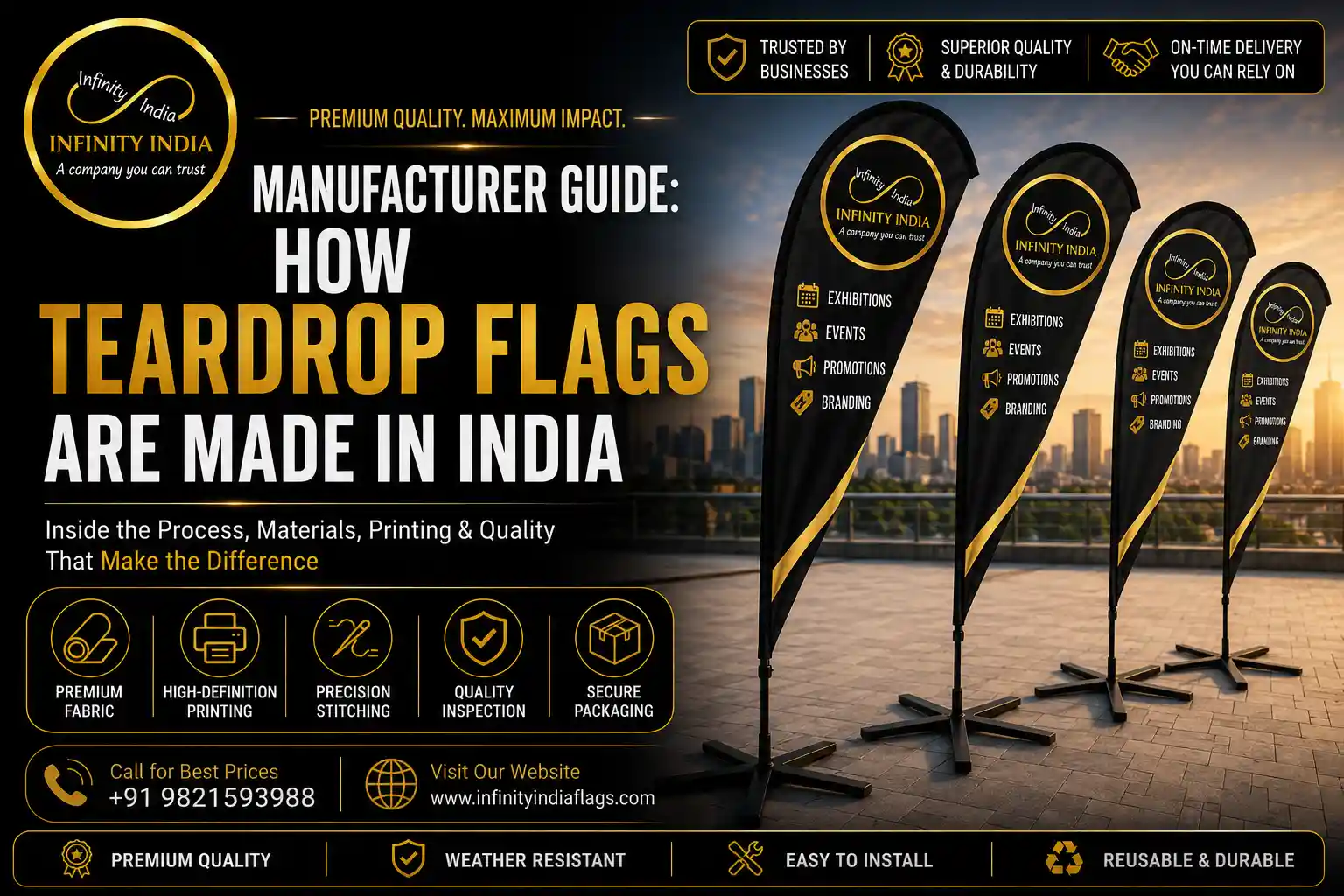
Teardrop flags have become one of the most effective outdoor advertising solutions for businesses looking to attract attention at exhibitions, retail stores, corporate events, automobile dealerships, real estate projects, shopping malls, educational institutions, sports tournaments, and promotional campaigns. Their distinctive curved shape, lightweight structure, and vibrant printing make them highly visible even from a distance.
However, not all teardrop flags offer the same level of performance. While many suppliers sell promotional flags, only experienced manufacturers understand how material selection, printing technology, stitching quality, and finishing directly affect durability, colour vibrancy, and overall return on investment.
If you’re planning to order teardrop flags in bulk, understanding the manufacturing process can help you choose a supplier that delivers long-lasting products rather than low-cost alternatives that fade, tear, or lose their shape after limited outdoor use.
In this comprehensive guide, we’ll explain how premium-quality teardrop flags are manufactured in India—from selecting the right fabric to high-definition printing, industrial stitching, quality inspection, and packaging. Whether you’re a marketing agency, event organizer, retail chain, dealership, or corporate buyer, this guide will help you make an informed purchasing decision.
What Is a Teardrop Flag?
A teardrop flag is a portable promotional display designed with a curved top and tapered bottom, resembling the shape of a teardrop. Unlike traditional rectangular banners, the tension created by its flexible fiberglass or aluminium pole system keeps the fabric stretched, ensuring your branding remains visible even in light wind conditions.
- These flags are widely used for:
- Retail storefront promotions
- Trade fairs and exhibitions
- Corporate branding
- Product launches
- Real estate marketing
- Educational institutions
- Sports events
- Hotels and resorts
- Restaurants and cafés
- Petrol pumps
- Automobile showrooms
- Political campaigns
- Government awareness programs
Their portability, weather resistance, and high visibility make them one of the most cost-effective outdoor branding tools available.
If you’re looking for professionally manufactured custom promotional flags, choosing a manufacturer with in-house production capabilities ensures better quality control and faster delivery than buying through traders.
Why Manufacturing Quality Matters
One of the biggest mistakes buyers make is comparing suppliers solely based on price.
At first glance, two teardrop flags may look almost identical online. However, their manufacturing quality can vary significantly.
A premium-quality teardrop flag typically offers:
- Better colour vibrancy
- Longer outdoor lifespan
- UV-resistant printing
- Stronger stitching
- Reinforced pole pockets
- Improved wind resistance
- Superior fabric strength
- Consistent print quality across bulk orders
- On the other hand, low-quality flags often suffer from:
- Colour fading within a few months
- Fabric tearing around stitched area
- Uneven printing
- Wrinkles caused by poor heat fixing
- Weak pole sleeves
- Inferior finishing
- Reduced visibility due to dull colours
For businesses investing in branding, these quality differences directly impact brand perception. A professionally manufactured flag projects reliability, whereas a faded or damaged display can leave a poor impression on customers.
Step 1: Selecting the Right Fabric
Every premium teardrop flag begins with selecting the right fabric.
The fabric determines:
- Printing quality
- Wind resistance
- Durability
- Weight
- Colour absorption
- Outdoor performance
Most high-quality manufacturers in India use knitted polyester because it provides an excellent balance between durability and print clarity.
Common Fabric Options
180 GSM Satin Polyester
Ideal for:
- Indoor events
- Temporary promotions
- Exhibition booths
Advantages:
- Lightweight
- Economical
- Easy to transport
Limitations:
- Lower durability for continuous outdoor use.
240 GSM Knitted Polyester
This is generally considered the preferred choice for professional promotional flags.
Advantages include:
- Excellent colour reproduction
- Better wind flow
- Reduced tearing
- Stronger stitching support
- Longer outdoor life
This fabric category is commonly selected for retail branding, dealerships, exhibitions, and corporate events because it combines durability with vibrant printing.
Heavy-Duty Polyester
Designed for demanding outdoor environments, this option is suitable for:
- Coastal regions
- Industrial facilities
- Long-term installations
- High-wind locations
Although heavier fabrics offer added strength, they also increase the overall weight of the flag. Manufacturers therefore select fabric weight carefully based on the intended application to maintain smooth movement and structural performance.
Understanding Fabric GSM
GSM stands for “Grams Per Square Metre” and indicates the weight of the fabric.
Contrary to common belief, a higher GSM does not automatically mean a better flag.
An experienced manufacturer chooses the fabric based on:
- Pole flexibility
- Wind conditions
- Installation height
- Printing method
- Intended duration of use
For example, a flag used at an indoor exhibition may perform best with a lighter GSM, while a dealership displaying flags outdoors throughout the year benefits from a more durable knitted polyester that balances strength with airflow.
Selecting the right combination of fabric, printing process, and finishing is what differentiates premium manufacturers from suppliers focused only on low prices.
In the next section, we’ll explore how artwork is prepared, why colour management is essential, and how modern dye-sublimation printing creates vibrant, weather-resistant graphics that make teardrop flags stand out in any environment.
Step 2: Artwork Preparation – The Foundation of a High-Quality Teardrop Flag
Before any printing begins, the customer’s artwork is carefully reviewed and prepared. This stage is often overlooked by buyers, but it has a significant impact on the final appearance of the flag. Even the highest-quality fabric and printing equipment cannot compensate for poorly prepared artwork.
Professional manufacturers work with vector-based design files such as AI, EPS, PDF, or SVG because these formats allow graphics to be scaled without losing quality. High-resolution PNG or PSD files may also be used when vector artwork is unavailable, provided they meet the required print resolution.
During the artwork preparation process, the design team checks:
- Logo clarity and sharpness
- Image resolution (typically 150–300 DPI at full print size)
- Text readability from a distance
- Colour accuracy
- Safe margins and bleed areas
- Placement within the teardrop template
- Orientation for single-sided or double-sided printing
Unlike rectangular banners, teardrop flags have a curved top and tapered edge. This unique shape means that artwork must be adjusted specifically for the flag template to ensure important elements such as logos, slogans, and contact details are not distorted or cut off during production.
CMYK vs RGB Colour Profiles
Another critical aspect of artwork preparation is colour management.
Most digital designs are created using the RGB colour model, which is optimized for screens. However, commercial printing uses the CMYK colour model, which is designed for ink reproduction.
If artwork is not converted correctly, colours can appear different after printing. For example:
- Bright neon colours may become muted.
- Deep blues can shift toward purple.
- Vibrant greens may lose intensity.
- Corporate brand colours may not match existing marketing materials.
Experienced manufacturers use calibrated colour profiles and RIP (Raster Image Processing) software to achieve the closest possible match to the customer’s brand guidelines. This is especially important for franchises, corporate chains, and businesses that require consistent branding across multiple locations.
Step 3: High-Definition Dye Sublimation Printing
Printing is the heart of the manufacturing process.
The printing technology used determines:
- Colour vibrancy
- Sharpness
- Weather resistance
- Washability
- UV durability
- Long-term appearance
Most premium teardrop flags in India are produced using dye sublimation printing, which has become the preferred method for fabric-based promotional displays.
Unlike traditional surface printing, dye sublimation transforms solid ink into gas under high temperature and pressure. The ink penetrates deep into the polyester fibres instead of simply sitting on the surface. This creates a permanent bond between the ink and the fabric.
Why Dye Sublimation Is Preferred
Compared with older printing methods, dye sublimation offers several advantages:
- Brilliant, photo-quality colours
- Smooth gradients and fine details
- Crack-resistant prints
- ]Fade-resistant graphics
- Excellent wash durability
- Lightweight fabric feel
- Better flexibility during wind movement
Because the ink becomes part of the fabric rather than forming a surface layer, the finished flag remains soft, lightweight, and able to move naturally in outdoor conditions.
The Dye Sublimation Process Explained
1.Digital Printing
The approved artwork is printed onto specially coated transfer paper using industrial digital printers. These printers are capable of reproducing highly detailed graphics, vibrant colours, and smooth gradients with exceptional precision.
2.Heat Transfer
The printed transfer paper is aligned with the polyester fabric and passed through a high-temperature heat press.
Temperatures typically exceed 190°C, causing the dye to convert directly into gas.
Instead of remaining on the paper, the dye permanently infuses into the polyester fibres.
3.Permanent Colour Bonding
As the fabric cools, the dye becomes locked within the fibres.
The result is:
- Long-lasting colour
- No peeling
- No cracking
- Excellent flexibility
- Resistance to everyday wear
This process ensures that the printed design remains vibrant even after prolonged exposure to sunlight and regular outdoor use.
Single-Sided vs Double-Sided Printing
Professional manufacturers usually offer both single-sided and double-sided teardrop flags, depending on the customer’s branding requirements.
Single-Sided Printing
Single-sided flags are the most popular choice because they are:
- Lightweight
- Cost-effective
- Suitable for outdoor advertising
- Easier to manufacture
- Ideal for bulk promotional campaigns
With dye sublimation printing, the artwork printed on one side is visible on the reverse side in a mirrored format. Depending on the fabric used, the reverse image typically achieves around 85–95% colour visibility, making it suitable for most outdoor branding applications.
Double-Sided Printing
Double-sided flags are manufactured differently.
Two separately printed fabric panels are stitched together with an internal blackout layer that prevents graphics from showing through.
This construction allows:
- Correct reading from both sides
- Rich, vibrant colours on each face
- Greater visual impact in indoor exhibitions
- Enhanced brand presentation at premium events
Although double-sided flags are heavier and more expensive than single-sided versions, they are often preferred for high-end exhibitions, luxury retail environments, corporate headquarters, and promotional displays where branding quality is the top priority.
Step 4: Precision Cutting for a Perfect Shape
After printing, the fabric moves to the cutting department.
Precision cutting is essential because even a small deviation can affect the overall appearance of the finished flag.
Modern manufacturing facilities use computer-generated templates or precision cutting equipment to ensure that every flag matches the exact dimensions required for its size.
The curved profile of a teardrop flag demands particular accuracy. Poor cutting can lead to wrinkles, uneven tension, or distorted graphics once the flag is mounted on its pole.
Each panel is carefully aligned before cutting to ensure logos, images, and text remain centred and visually balanced. This attention to detail is especially important for businesses that rely on consistent branding across multiple flags in bulk orders.
By maintaining strict dimensional accuracy at this stage, manufacturers ensure that every finished teardrop flag displays smoothly, retains its distinctive shape, and performs reliably in both indoor and outdoor environments.
Step 5: Industrial Stitching and Reinforcement
Once the printed fabric has been precision-cut, it moves to the stitching department, where individual pieces are transformed into a finished teardrop flag. Although printing often gets the most attention, stitching quality plays an equally important role in determining the flag’s lifespan.
Outdoor promotional flags are constantly exposed to wind pressure, sunlight, rain, and repeated installation. Poor stitching can lead to frayed edges, torn seams, or damaged pole sleeves within a short period of use. This is why experienced manufacturers invest in industrial sewing equipment and trained technicians to ensure consistent quality.
Double-Stitched Edges for Added Strength
High-quality teardrop flags are typically finished with double-stitched hems instead of a single stitch. Double stitching distributes tension more evenly across the fabric, reducing the likelihood of seam failure when the flag is exposed to strong winds or frequent movement.
Benefits include:
- Improved tear resistance
- Longer product lifespan
- Cleaner and more professional finish
- Better durability for outdoor applications
For high-wind locations such as highways, petrol pumps, industrial estates, or large commercial complexes, reinforced stitching becomes even more important.
Pole Pocket Construction
The pole pocket is one of the most critical components of a teardrop flag.
This sleeve holds the fiberglass or aluminium pole and keeps the fabric under tension, giving the flag its signature shape. Because this area experiences the highest mechanical stress, it requires additional reinforcement during manufacturing.
Professional manufacturers use heavy-duty polyester webbing or reinforced fabric around the pole pocket to improve durability. Multiple rows of stitching are often added to prevent tearing during repeated installation and removal.
A well-constructed pole pocket offers several advantages:
- Smooth flag tension
- Better wind performance
- Reduced wear around the pole
- Longer service life
- Easier installation
This attention to structural detail is one of the key differences between premium manufacturers and low-cost suppliers.
Corner Reinforcement
The top and bottom corners of a teardrop flag experience the greatest stress during outdoor use.
To prevent premature wear, manufacturers reinforce these areas using additional layers of fabric or heavy-duty webbing. These reinforcement patches help distribute tension evenly and reduce the risk of tearing.
This is particularly beneficial for:
- Long-term outdoor installations
- Coastal environments
- High-wind regions
- Large-format teardrop flags
Step 6: Quality Inspection Before Dispatch
Every professionally manufactured teardrop flag should undergo a comprehensive quality inspection before it is approved for dispatch.
Skipping this step can result in production defects reaching customers, leading to unnecessary replacements, increased costs, and reduced customer satisfaction.
Leading manufacturers inspect every flag for:
- Print sharpness
- Colour consistency
- Fabric defects
- Accurate dimensions
- Stitching quality
- Pole pocket alignment
- Loose threads
- Finishing quality
- Packaging accuracy
Only products that meet predefined quality standards proceed to packing and shipping.
Colour Accuracy and Brand Consistency
Businesses invest heavily in branding, making colour consistency a critical requirement—especially for companies with multiple branches or nationwide marketing campaigns.
Manufacturers therefore compare printed samples against approved artwork to ensure:
- Logos match brand guidelines
- Corporate colours remain consistent
- Text is crisp and legible
- Images retain proper contrast
Maintaining consistent colours across large production batches is particularly important for franchises, retail chains, event management companies, and advertising agencies.
UV Resistance Testing
Outdoor advertising flags are continuously exposed to sunlight, making UV resistance an important quality factor.
Premium dye-sublimation inks are designed to resist fading, helping the graphics maintain their vibrancy even after prolonged outdoor exposure.
While environmental conditions vary, high-quality UV-resistant printing generally offers significantly better colour retention than standard low-cost printing methods.
This makes UV-resistant inks especially suitable for:
- Retail outlets
- Shopping centres
- Automobile dealerships
- Fuel stations
- Outdoor exhibitions
- Sports venues
Wind Performance and Durability Testing
A teardrop flag should not only look attractive—it must also withstand everyday outdoor conditions.
Before dispatch, manufacturers assess how the finished flag performs under normal operating conditions. They verify:
- Proper fabric tension
- Secure stitching
- Smooth pole movement
- Balanced shape
- Overall structural integrity
Choosing the correct combination of fabric weight, reinforcement, and pole flexibility allows the flag to move naturally with the wind while reducing unnecessary stress on the seams.
Step 7: Packaging and Bulk Order Preparation
Once production and quality checks are complete, the flags are prepared for packaging.
Proper packaging protects the product during transportation and ensures that customers receive flags in excellent condition.
Depending on the order requirements, packaging may include:
- Folded or rolled flags
- Pole sets
- Ground spikes
- Cross bases
- Water bags for additional stability
- Carry bags for easy transportation
- Installation instructions
For corporate buyers and distributors, products can also be packed according to specific inventory or project requirements, simplifying distribution across multiple locations.
Bulk Manufacturing for Corporate Orders
One of the biggest advantages of working with an experienced Indian manufacturer is the ability to handle large-volume production efficiently.
Whether the requirement is 50 flags for a regional promotion or several thousand units for a nationwide campaign, established manufacturing facilities follow streamlined production processes to maintain consistency across every piece.
Bulk manufacturing typically includes:
- Standardised colour calibration
- Batch-wise quality inspections
- Uniform stitching standards
- Consistent sizing
- Coordinated production timelines
- Secure packaging for transportation
This ensures that every flag delivered reflects the same level of quality, helping businesses maintain a professional and consistent brand image across all locations.
How to Choose the Right Teardrop Flag Manufacturer in India
Selecting the right manufacturer is just as important as choosing the right product. While many suppliers offer teardrop flags, not all have the expertise, production capabilities, or quality control systems required to deliver consistent results.
Whether you are ordering 10 flags for a retail promotion or thousands for a nationwide branding campaign, evaluating a manufacturer beyond pricing can save both time and money in the long run.
Here are some important factors to consider before placing your order:
1.In-House Manufacturing
Manufacturers with their own production facilities have greater control over quality, production timelines, and customization. In-house manufacturing also reduces dependency on third-party vendors, resulting in more consistent products and faster turnaround times.
2.Printing Technology
Ask which printing process is used. Professional manufacturers typically use dye sublimation printing for polyester flags because it delivers vibrant colours, sharp graphics, and excellent durability.
Avoid suppliers who cannot clearly explain their printing process or the quality of inks they use.
3.Fabric Quality
The fabric directly affects the appearance and lifespan of the flag. Reliable manufacturers use premium knitted polyester designed specifically for outdoor advertising applications.
The right fabric should offer:
- Good colour absorption
- Tear resistance
- Smooth airflow
- Long-term durability
- Excellent print clarity
4.Customisation Options
Every business has different branding requirements. Choose a manufacturer that can customise:
- Flag size
- Shape
- Artwork
- Pole systems
- Base options
- Packaging
- Bulk quantities
Working with a flexible manufacturer simplifies branding for exhibitions, retail stores, dealerships, corporate offices, and promotional events.
5. Quality Assurance
Professional manufacturers inspect products at multiple stages of production instead of relying solely on a final inspection.
Ask whether they perform:
- Colour checks
- Stitching inspections
- Dimension verification
- Print quality testing
- Packaging inspection
A structured quality assurance process significantly reduces production defects.
Common Mistakes Buyers Should Avoid
Many businesses focus only on the lowest quotation without considering product quality. This often leads to frequent replacements and higher long-term costs.
Some of the most common purchasing mistakes include:
Choosing Based Only on Price
A cheaper flag may use lower-grade fabric, poor-quality inks, or weaker stitching. Although the initial cost is lower, the product often needs replacement much sooner.
Ignoring Fabric Specifications
Not all polyester fabrics perform the same. Always ask about the GSM, weave, and intended application before placing an order.
Using Low-Resolution Artwork
Blurry logos and pixelated images reduce the professional appearance of the finished flag. Providing high-quality artwork ensures the best possible print results.
Selecting the Wrong Base
Different locations require different base systems. Ground spikes are suitable for soil and grass, while cross bases with water bags provide stability on hard surfaces.
Not Confirming Delivery Timelines
For exhibitions, product launches, or corporate events, production and delivery schedules are critical. Confirm manufacturing timelines before finalising your order.
Why Indian Manufacturers Are Becoming a Preferred Choice
India has emerged as one of the leading destinations for custom promotional flag manufacturing due to its combination of advanced printing technology, skilled workforce, and competitive production costs.
Today, Indian manufacturers supply customised flags for:
- Retail chains
- Event management companies
- Advertising agencies
- Automobile dealerships
- Government campaigns
- Educational institutions
- Hospitality businesses
- International distributors
Modern manufacturing facilities combine digital printing technology with skilled craftsmanship to produce products that meet global quality expectations while remaining cost-effective for bulk buyers.
Why Businesses Choose Infinity India Flags
At Infinity India Flags, every teardrop flag is manufactured with a strong focus on quality, durability, and visual impact.
From artwork preparation to final inspection, every stage of production follows a structured process designed to deliver consistent results for businesses across India.
Our manufacturing approach includes:
- Premium polyester fabric
- High-definition dye sublimation printing
- Precision cuttin
- Reinforced stitching
- Durable pole pocket constructio
- Strict quality inspections
- Custom sizes and branding options
- Bulk production capabilitie
- Reliable nationwide delivery
Whether you require promotional flags for a retail store, an exhibition, a dealership, a sporting event, or a nationwide marketing campaign, our team can manufacture customized solutions tailored to your branding requirements.
If you’re planning to order custom promotional flags, explore our Teardrop Flags collection to discover a wide range of sizes, accessories, and customisation options designed for professional outdoor advertising.
Conclusion
A high-quality teardrop flag is much more than a printed piece of fabric. It is the result of careful material selection, precision printing, skilled stitching, rigorous quality inspection, and professional manufacturing processes.
Understanding how teardrop flags are made helps businesses make informed purchasing decisions rather than comparing products solely on price.
By choosing an experienced manufacturer with advanced printing technology, premium materials, and robust quality control, businesses can invest in advertising displays that deliver long-lasting performance, vibrant branding, and excellent value over time.
Whether you need a few customised flags or a large-scale bulk order, partnering with an experienced manufacturer ensures your brand stands out at every event, exhibition, showroom, and promotional campaign.
Ready to create premium-quality custom teardrop flags? Visit our Teardrop Flags page to explore our products, request a custom quotation, or speak with our team about your bulk manufacturing requirements.
Frequently Asked Questions
1. What material is used to manufacture teardrop flags?
Most premium teardrop flags are manufactured using knitted polyester because it offers excellent print quality, durability, and resistance to outdoor weather conditions.
2. Which printing method is best for teardrop flags?
Dye sublimation printing is considered the industry standard because it produces vibrant colours, sharp graphics, and long-lasting prints that become part of the fabric.
3. Are teardrop flags waterproof?
Most polyester teardrop flags are water-resistant and suitable for outdoor use. However, proper drying before storage helps extend their lifespan.
4. How long do teardrop flags last outdoors?
The lifespan depends on environmental conditions, fabric quality, printing technology, and maintenance. Premium-quality flags generally provide significantly better durability than low-cost alternatives.
5. Can I customize the size and design?
Yes. Professional manufacturers offer complete customisation, including size, shape, artwork, colours, and accessories.
6. Which base should I choose?
Ground spikes work well for soil or grass, while cross bases with water bags provide stability on hard indoor or outdoor surfaces.
7. Can teardrop flags be used indoors?
Absolutely. They are widely used at exhibitions, shopping malls, corporate offices, conferences, product launches, and retail stores.
8. What is the minimum order quantity?
The minimum order quantity varies by manufacturer. Many suppliers can accommodate both small custom orders and large-volume production.
9. Are double-sided teardrop flags available?
Yes. Double-sided flags feature two printed fabric panels with a blackout layer in between, allowing the artwork to display correctly from both sides.
10. Why should I buy directly from a manufacturer?
Buying directly from a manufacturer often provides better quality control, greater customisation, competitive pricing for bulk orders, and faster production compared to purchasing through resellers.
“`html “`